
Best AI SEO Tools for B2B Marketers (2026)
Sixty percent of B2B buyers now use AI assistants — ChatGPT, Perplexity, Gemini — before they ever open Google. Click-through rates drop by nearly half when an AI Overview sits above the organic results. And the January 2026 algorithm update reshuffled rankings in almost every B2B niche.
The bottom line: the SEO stack that worked in 2024 is a liability in 2026. You need tools that handle traditional search and AI-generated answers, because your buyers use both — often in the same research session.
We tested 10 platforms over three months, on real B2B campaigns, with real budgets. This guide tells you which tools delivered and which ones are coasting on hype.
Why Your SEO Stack Is Already Outdated
AI SEO tools are platforms that use machine learning and natural language processing to automate keyword research, content optimization, technical audits, competitive analysis, link building and rank tracking. That part has not changed.
What has changed — dramatically — is the surface area these tools need to cover.
Google AI Overviews now appear in more than 25% of search results. ChatGPT answers buying queries before a user ever clicks a link. Perplexity cites sources inline, turning your content into a footnote — or leaving you out entirely. A CMO evaluating marketing automation software is just as likely to prompt an AI assistant for a shortlist as they are to type a query into Google.
If your brand does not show up in both channels, you are invisible during the most critical stage of the buying cycle.
Three shifts make upgrading your AI SEO tools urgent right now:
Zero-click search is the default. When an AI Overview is present, organic CTR drops from roughly 15% to 8%. Your content strategy must account for answers that never generate a click.
Content velocity has exploded. Competitors publish faster than ever with AI writing tools. Lean B2B teams cannot keep pace without AI-assisted optimization.
GEO is no longer optional. Generative Engine Optimization — getting your brand cited by AI models — is a real discipline with measurable metrics. Ignoring it means conceding visibility to competitors who do not.
SEO vs. GEO — The Two Fronts B2B Teams Need to Win
Before diving into tools, it is worth understanding the two games you are now playing simultaneously.
SEO (Search Engine Optimization) targets traditional search results. The goal is rankings, clicks and traffic from Google, Bing and other search engines. Metrics: keyword positions, organic traffic, click-through rate, conversions.
GEO (Generative Engine Optimization) targets AI-generated answers. The goal is brand citations in ChatGPT, Perplexity, Google AI Overviews, Gemini and Claude. Metrics: AI mentions, citation share, AI share of voice.
GEO is different from SEO in three fundamental ways:
Citations over clicks. The goal is not a click — it is getting your brand named as a trusted source in an AI answer. The buyer may never visit your site, but they now know you exist.
Content depth beats keyword density. AI models favor comprehensive, semantically rich content. Studies show that content depth, sentence count and readability drive AI citations more than backlinks or keyword placement.
Source authority is weighted differently. AI models lean toward content that demonstrates expertise, experience, authority and trustworthiness (E-E-A-T). Original research, case studies and expert-driven content earn more AI visibility than generic blog posts.
The best AI SEO tools in 2026 cover both fronts. The comparison below evaluates each tool on traditional SEO power and GEO capability — because you need both.
Read here how to get your brand cited by ChatGPT.
How We Evaluate AI SEO Tools
Every tool in this guide was scored on five criteria designed for B2B marketing teams:
B2B use case fit. Does the tool solve problems that matter for pipeline-driven marketers? We prioritize platforms that support long-cycle content strategies — not viral social hacks.
AI capabilities. Is the AI genuinely useful, or is it autocomplete with a marketing label? We test whether AI features actually improve output quality and save meaningful time.
Data accuracy. Keyword volumes, difficulty scores and traffic estimates vary wildly between platforms. We cross-reference data against Google Search Console to check reliability.
Integration depth. B2B teams run complex stacks. We evaluate how well each tool connects with Google Analytics, Search Console, WordPress, CRMs and other marketing platforms.
Pricing transparency. No hidden upsells, no bait-and-switch on AI credits. We flag tools where the real cost diverges from the advertised price.
The 10 Best AI SEO Tools — Tested and Compared
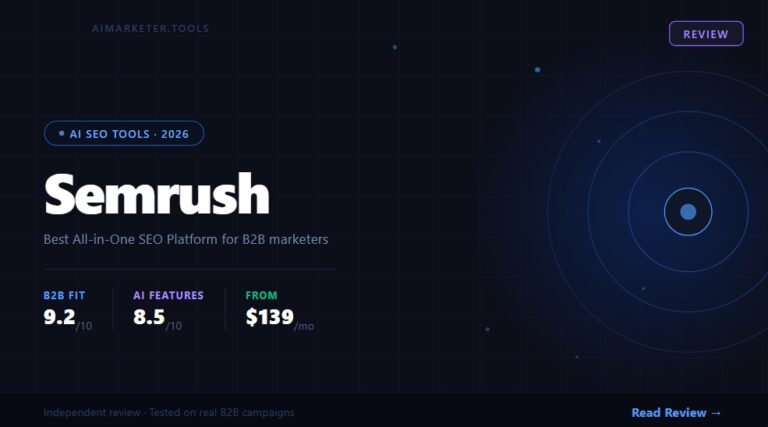
Semrush — Best All-in-One SEO Platform
Best for: Agencies, in-house teams and B2B companies that need keyword research, competitive intelligence, site audits and AI visibility in one platform.
Semrush remains the most comprehensive SEO platform on the market. Its Keyword Magic Tool gives access to over 25 billion keywords across 142 geographic databases.
What earns it the top spot in 2026 is the depth of its AI layer. The AI Copilot surfaces recommendations from your existing Semrush data — flagging keyword opportunities, content decay and technical issues before you ask. ContentShake AI bridges keyword research and content execution by suggesting topics, generating SEO-optimized outlines and producing drafts that respect your brand voice.
For AI visibility, Semrush now tracks brand mentions across ChatGPT, Perplexity, Google AI Overviews and Gemini. The AI Share of Voice metric shows your brand’s presence relative to competitors in AI-generated answers.
Pros: Widest feature set on the market. Strong AI Copilot. Four-platform AI visibility tracking. 14-day free trial on Pro and Guru. Cons: Expensive — Pro starts at $139/month. Full AI toolkit requires higher tiers. Interface can feel overwhelming with 55+ features. Pricing: From $139/month (Pro) to custom Enterprise plans.
The safest all-in-one bet for established B2B teams with budget.
Search Atlas — Best for AI SEO Automation
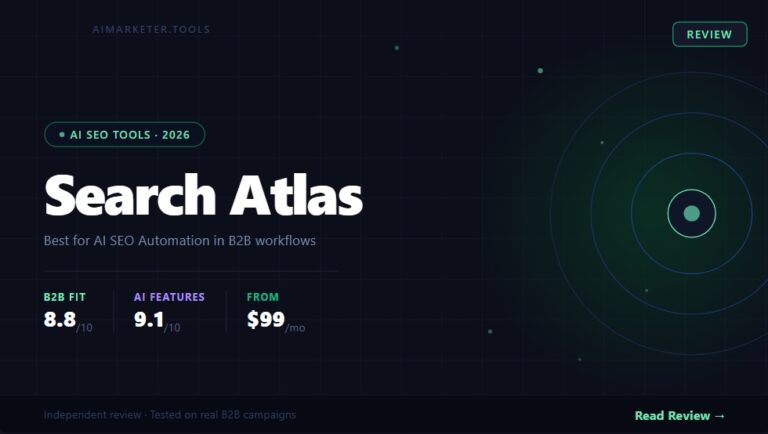
Best for: Agencies and B2B teams that want an AI agent to detect, recommend and deploy SEO fixes directly on their site.
Search Atlas is the most AI-native platform on this list. Its headline feature, OTTO SEO, is an autonomous AI agent that scans your website, identifies technical issues and applies corrections — meta tags, schema markup, canonical URLs, broken links — directly from the dashboard once you approve them. No other mainstream tool automates execution at this level.
Beyond automation, Search Atlas includes Content Genius for AI-powered article generation with semantic SEO, keyword research across 5.2 billion keywords, rank tracking and LLM visibility tracking across ChatGPT, Claude and Gemini.
The platform has grown fast — over 50,000 websites and 5,000+ agencies use it. But it is younger than Semrush or other established players, and that shows in places. Some users have reported bugs with the WordPress plugin, and the keyword database is still smaller than the market leaders. The AI automation is genuinely impressive, but treat OTTO’s suggestions with the same scrutiny you would apply to any automated change to your production site.
Pros: OTTO SEO agent is unique — no competitor offers autonomous fix deployment. LLM visibility tracking. Content Genius for AI writing. 7-day free trial. Strong value at $99/month. Cons: Smaller keyword database than Semrush. Some WordPress plugin stability issues reported. OTTO requires careful review — automated changes can break things if not checked. Younger platform with less community support. Pricing: From $99/month (Starter) to $399/month (Pro).
The most innovative AI SEO tool on the market — but verify before you automate
Surfer SEO — Best for Content Optimization
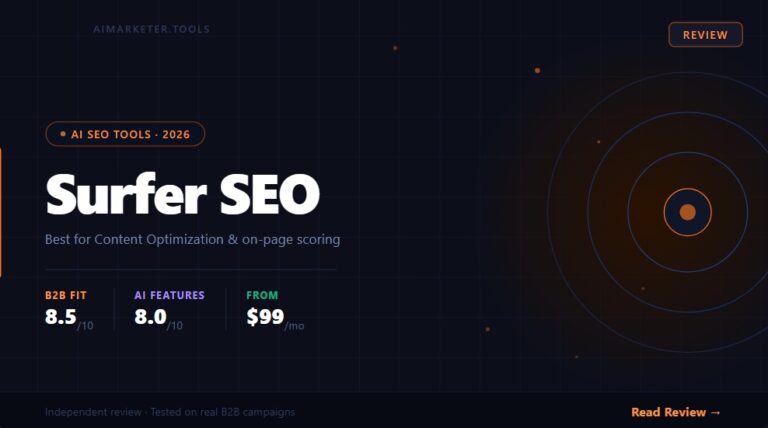
Best for: Content teams that need NLP-driven optimization to create articles that rank in both traditional search and AI Overviews.
Surfer does one thing exceptionally well: it tells you exactly what to write to compete with top-ranking pages for any keyword. The Content Editor analyzes competitors, then guides you on terms to include, heading structure, target word count and how to score against the current SERP.
For B2B teams producing long-form content — thought leadership, product comparisons, industry guides — Surfer compresses the optimization cycle. The real-time Content Score updates as you write, and integrations with Google Docs and WordPress mean you never leave your writing environment.
Recent updates added AI Visibility Tracking on Pro plans and above, brand voice controls, a plagiarism checker, a Humanizer to reduce AI-sounding prose, rank-drop detection and cannibalization reports.
Pros: Best-in-class content scoring. AI visibility tracking now included. Google Docs and WordPress integrations. Humanizer for AI content quality. Cons: Keyword research is basic — you still need a dedicated research tool. Essential plan starts at $99/month (up from $89). AI visibility only on Pro+. Pricing: From $99/month (Essential) to custom Enterprise.
The optimization layer every B2B content team should pair with a research tool.
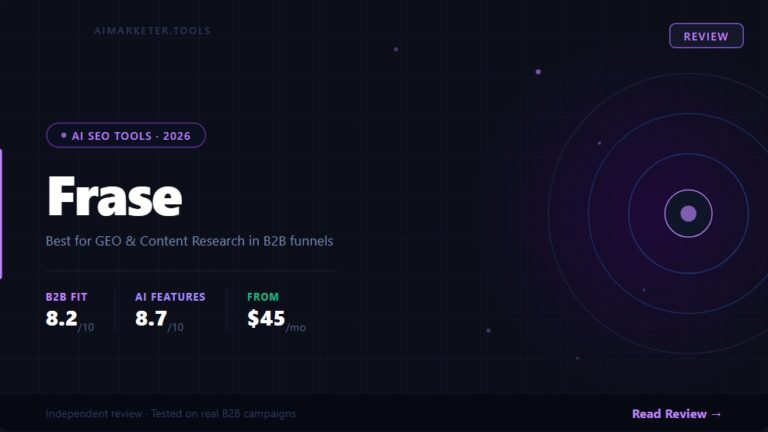
Frase — Best for GEO & Content Research
Best for: Teams focused on Generative Engine Optimization and content research workflows.
Frase has evolved from a content brief tool into a full agentic SEO platform. Its AI Agent handles research, writing, optimization and publishing in a single workflow.
What sets Frase apart is GEO depth. It tracks AI visibility across eight platforms and includes a Content Watchdog that monitors citation decay — alerting you when AI models stop referencing your content. For B2B companies that depend on being cited in AI-generated vendor comparisons, this is essential.
Frase also offers read-write MCP server access, meaning AI agents like Claude can execute the full content pipeline through Frase’s tools — opening automation possibilities most competitors cannot match.
The research interface remains one of the fastest ways to analyze what is ranking for any keyword. Type a target term and Frase shows headings, FAQs, related topics and content gaps across the top results.
Pros: Broadest GEO tracking (8 platforms). Content Watchdog for citation monitoring. MCP integration. Lowest entry price on this list ($15/month). Cons: Smaller keyword database than Semrush. Less mature site audit. Content editor not as polished as Surfer’s. Pricing: From $15/month (Solo) to $115/month (Team).
The best value for GEO-first B2B teams — and it is not even close on price.
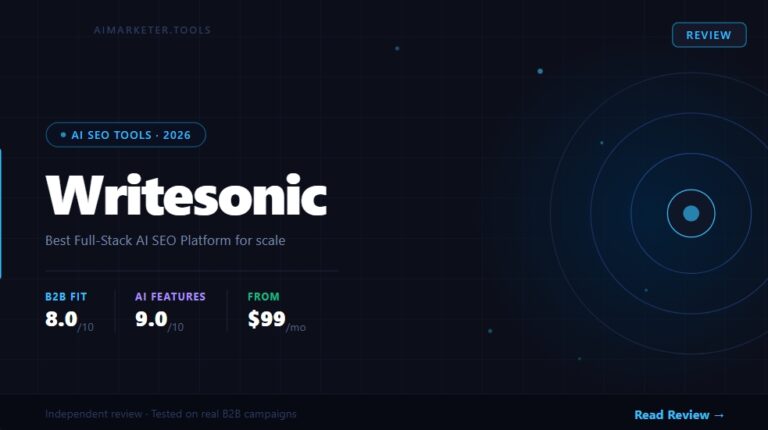
Writesonic — Best Full-Stack AI SEO Platform
Best for: Teams that want content creation, SEO optimization and AI visibility tracking in a single platform.
Writesonic repositioned itself as a fully automated SEO platform in 2026. The Article Writer generates SEO-ready drafts with proper heading structure, integrated keywords and suggested meta descriptions — pulling in real-time web data for accuracy.
The standout feature is Chatsonic, an AI agent that connects to multiple LLMs (GPT-4o, Claude, Gemini) and pulls real-time data from Google Search Console, Semrush and other sources. You can ask it to audit a page, suggest keyword gaps or restructure content — and it responds with data-backed, actionable recommendations.
The brand voice feature lets you upload style guides and sample content so output matches your tone. For B2B teams producing 10+ articles per month, this removes the biggest bottleneck in the content pipeline.
Pros: End-to-end content production. Chatsonic multi-LLM agent. Real-time web data during generation. AI visibility tracking. WordPress integration. Cons: Output quality is inconsistent — some drafts are 70% ready, others need heavy editing. Plan for an editorial pass on everything. Pricing: From $49/month (Lite) to $499/month (Advanced).
The fastest content engine if you have an editor to quality-check output.
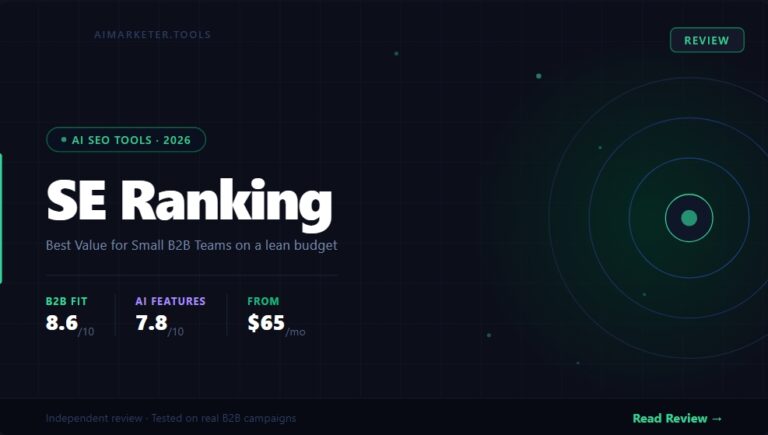
SE Ranking — Best Value for Small Teams
Best for: Small B2B teams and solo marketers who need enterprise-grade features at a reasonable price.
SE Ranking has emerged as the value leader in all-in-one SEO. It offers keyword research, rank tracking, site audits, backlink analysis, content optimization, competitive intelligence and AI-driven predictive analytics — all at roughly half the price of the market leaders.
The Content Editor builds briefs, suggests related terms and headings, and scores content. It integrates with Google Docs and ties into the broader SE Ranking suite for a unified workflow. The platform also includes AI ranking analysis with predictive capabilities, helping teams forecast how content changes and backlinks might affect performance.
Pros: Full-suite SEO at the best price. Solid data accuracy. Google Docs integration. Predictive analytics. 14-day free trial. Cons: AI features are less mature than Semrush or Search Atlas. Basic AI visibility tracking. Smaller keyword database. Pricing: From $52/month (Essential).
The most SEO you can get for the least money — ideal for teams that cannot justify $130+/month.
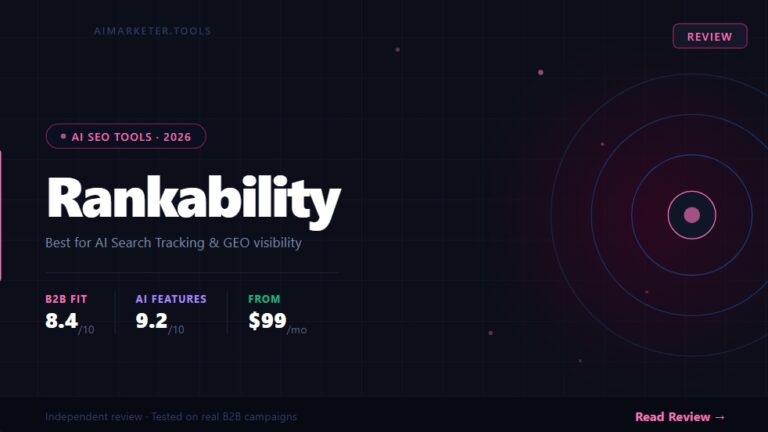
Rankability — Best for AI Search Tracking
Best for: SEO teams that want NLP content optimization combined with AI search visibility tracking in one platform.
Rankability combines content optimization with AI search tracking in a way that most competitors separate into two products. The Content Optimizer uses NLP to score content against what both Google and AI models are looking for — a dual scoring approach that is unique on this list.
The AI search tracking feature monitors brand mentions across ChatGPT, Perplexity and Gemini, giving visibility into how AI systems present your brand. For B2B teams running both SEO and GEO strategies, having both capabilities in one interface saves time and reduces tool sprawl.
Rankability is a newer platform with a smaller user base, which means less community content and fewer third-party integrations. But the product is focused, well-executed and competitively priced.
Pros: Dual SEO + GEO content scoring. AI visibility tracking (3 platforms). Competitive price. The platform is built for the AI search era, not retrofitted. Cons: Newer platform — smaller community and less third-party support. Limited integrations compared to established players. Pricing: From $49/month (Creator).
A compelling all-in-one for teams that want GEO built into optimization from the ground up.
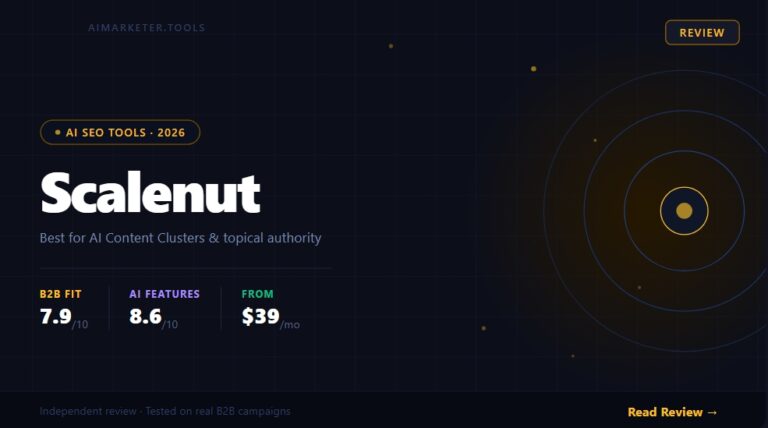
Scalenut — Best for AI Content Clusters
Best for: Content strategists who need AI-powered topic clustering, automated content generation and NLP optimization in one workflow.
Scalenut combines what MarketMuse does at the strategy level with what Surfer does at the content level — and adds AI generation on top. The Cruise Mode generates full SEO-optimized articles in minutes: you input a keyword, Scalenut builds a brief, generates an outline, writes the draft and runs NLP optimization in a single automated flow.
The Topic Cluster Builder maps out content clusters around a seed topic, identifying gaps and prioritizing pages by opportunity. For B2B teams running hub-and-spoke content strategies, this is the strategic layer that most AI writing tools miss.
The NLP content optimizer is solid — not as granular as Surfer’s, but good enough for most use cases and included in the platform rather than sold separately.
Pros: Cruise Mode for end-to-end content automation. Topic cluster planning built in. NLP optimizer included. Affordable entry point ($39/month). Cons: Cruise Mode drafts need editing — treat them as strong first drafts, not publish-ready content. Keyword database is smaller than Semrush or SE Ranking. Less proven track record than established tools. Pricing: From $39/month (Essential) to $149/month (Pro).
The tool that bridges content strategy and content execution with AI doing the heavy lifting.
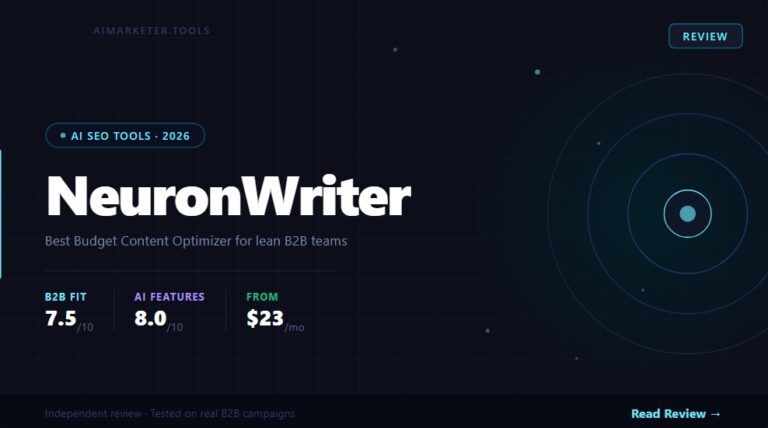
NeuronWriter — Best Budget Content Optimizer
Best for: Solo marketers and small teams that need NLP content optimization at a fraction of the price of premium tools.
NeuronWriter uses Google’s Natural Language Processing API directly to analyze SERP competitors and generate content recommendations. This gives it an edge on semantic accuracy — the term suggestions come from the same NLP models Google uses to understand content.
The platform covers content optimization with real-time NLP scoring, competitor SERP analysis, AI-powered content drafting and internal linking suggestions. It integrates with Google Search Console for performance data and with WordPress for direct publishing.
For teams that find Surfer or Clearscope too expensive but still need data-driven content optimization, NeuronWriter delivers roughly 80% of the capability at a quarter of the price.
Pros: Google NLP API integration for high-accuracy semantic analysis. Strong content scoring. AI writer included. Extremely affordable ($23/month). WordPress integration. Cons: Interface is less polished than Surfer. No AI visibility or GEO tracking. Smaller user base means fewer tutorials and community resources. Fewer integrations. Pricing: From $23/month.
The best content optimizer you can get for under $25/month — ideal for budget-conscious teams.
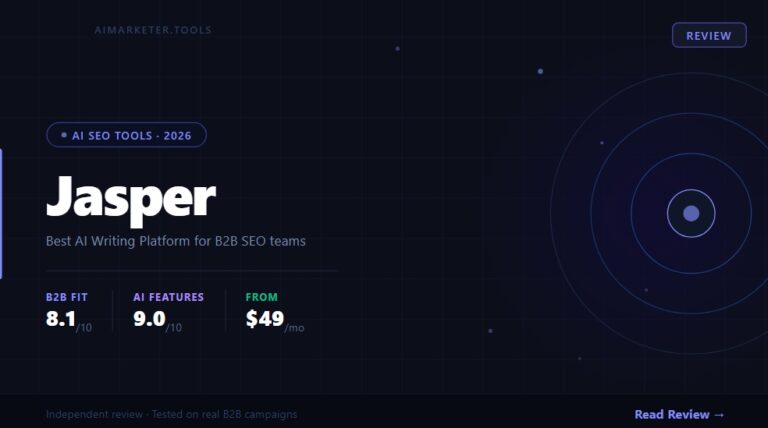
Jasper — Best AI Writing for SEO Teams
Best for: B2B content teams that need brand-consistent AI writing with built-in SEO optimization.
Jasper has positioned itself as the enterprise AI writing platform, and the SEO integration is what makes it relevant here. Jasper connects natively with Surfer SEO, which means you can generate AI content and optimize it for search in the same workflow — brand voice, keyword targets and NLP scoring all in one place.
The Brand Voice feature is the most sophisticated on this list. You can train Jasper on your company’s style guides, previous content, product documentation and tone preferences. For B2B teams where every piece of content needs to sound like it came from the same voice, this removes the biggest pain point of AI-generated content.
Jasper also offers campaign workflows, template libraries for different content types (blog posts, landing pages, ad copy, emails) and team collaboration features designed for marketing organizations.
Where Jasper falls short is everything outside of writing. It does not do keyword research, rank tracking, site audits or AI visibility tracking. You need a dedicated SEO tool alongside it — which is why the Jasper + Surfer combination is so common among B2B teams.
Pros: Best-in-class brand voice training. Native Surfer SEO integration. Campaign workflows for content teams. Enterprise-grade collaboration features. Cons: Not an SEO tool — no keyword research, rank tracking, site audits or AI visibility. Requires a separate SEO platform. Pricing starts at $49/month but scales quickly for teams. AI writing quality still requires editorial review. Pricing: From $49/month (Creator) to custom Business plans.
The best AI writer for SEO teams — but it needs a research tool to complete the stack.
Discover more AI SEO Articles
- All Posts
- Ai Tool Review
- Ai Tools for ad campaign management
- Ai Tools for better SEO ranking
- AI tools for content creation
- AI Tools for Data Analytics
- AI Tools for scaling email marketing
- AI Tools for Social Media
AI-Powered Technical SEO: Why Manual Audits Are Already Obsolete What is AI-powered technical SEO? It is the use of artificial...
How to Audit Your Website for AI Visibility in 60 Minutes Why Your Website Needs an AI Visibility Audit Right...
How to Get Your B2B Brand Cited by ChatGPT, Perplexity and Google AI Overviews Your buyers are asking AI for...