How to Get Your B2B Brand Cited by ChatGPT, Perplexity and Google AI Overviews
Your buyers are asking AI for recommendations before they ever open Google. A CMO searching for marketing automation software is just as likely to prompt ChatGPT as they are to type a query into a search engine. If your brand does not show up in those AI-generated answers, you are invisible at the most critical stage of the buying cycle.
This practice has a name: Generative Engine Optimization, or GEO. It is the discipline of structuring your content so that AI models — ChatGPT, Perplexity, Google AI Overviews, Gemini, Claude — cite your brand when they generate answers to user queries.
GEO is not a replacement for SEO. It is a new layer on top of it. And for B2B companies with long sales cycles, high average deal values and complex buying committees, getting cited in AI answers can influence pipeline in ways that traditional organic traffic never could.
Here is what we have learned after six months of optimizing B2B content for AI citations — what works, what does not, and how to start today.
Why AI Citations Matter More Than You Think
A citation in an AI-generated answer is fundamentally different from a Google ranking. When ChatGPT mentions your brand in response to a buying question, three things happen simultaneously.
First, you earn trust by association. The user did not search for you — the AI recommended you. That carries implicit endorsement weight, similar to a referral from a trusted colleague.
Second, you reach buyers earlier. Many AI-assisted research sessions happen before a buyer has formed a shortlist. If your brand appears at this stage, you shape the consideration set rather than competing to enter it later.
Third, the visibility compounds. AI models learn from content patterns. Brands that consistently produce authoritative, well-structured content on a topic get cited more frequently over time — creating a flywheel that is difficult for competitors to disrupt once established.
The challenge is that AI citations are not controlled the way paid ads or SEO rankings are. You cannot bid on them. You cannot guarantee them. But you can dramatically increase your probability of being cited by following specific content principles.
How AI Models Decide What to Cite
AI models do not rank pages the way Google does. They synthesize information from across the web and generate answers that draw on the most relevant, authoritative and clearly structured sources.
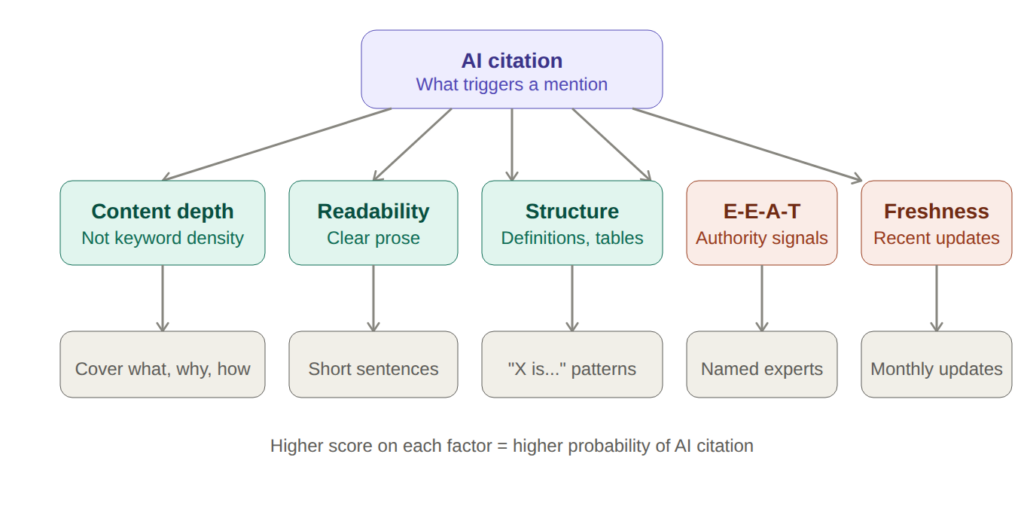
Research on GEO optimization has identified several content characteristics that correlate with higher citation rates in AI-generated answers.
Content depth over keyword density. AI models favor comprehensive answers that cover a topic thoroughly. Thin content optimized for a single keyword rarely gets cited. Long-form content that addresses multiple dimensions of a question — what, why, how, compared to what — performs significantly better.
Sentence count and readability. Studies show that content with higher sentence counts and clear, readable prose receives more AI citations. This makes sense — AI models need enough material to extract a meaningful answer, and they prefer content that is easy to parse.
Explicit definitions and structured claims. When your content clearly defines terms, states positions and structures arguments with evidence, AI models can extract and attribute those claims more easily. Vague, hedging language gets passed over.
E-E-A-T signals. AI models lean toward content from sources that demonstrate expertise, experience, authority and trustworthiness. Original research, named authors with credentials, case studies with real data and citations from other authoritative sources all strengthen your chances.
Freshness and recency. AI models weight recent content more heavily for topics where timeliness matters. Regularly updating your key content signals to AI systems that your information is current and reliable.
Seven Tactics to Get Your B2B Content Cited by AI
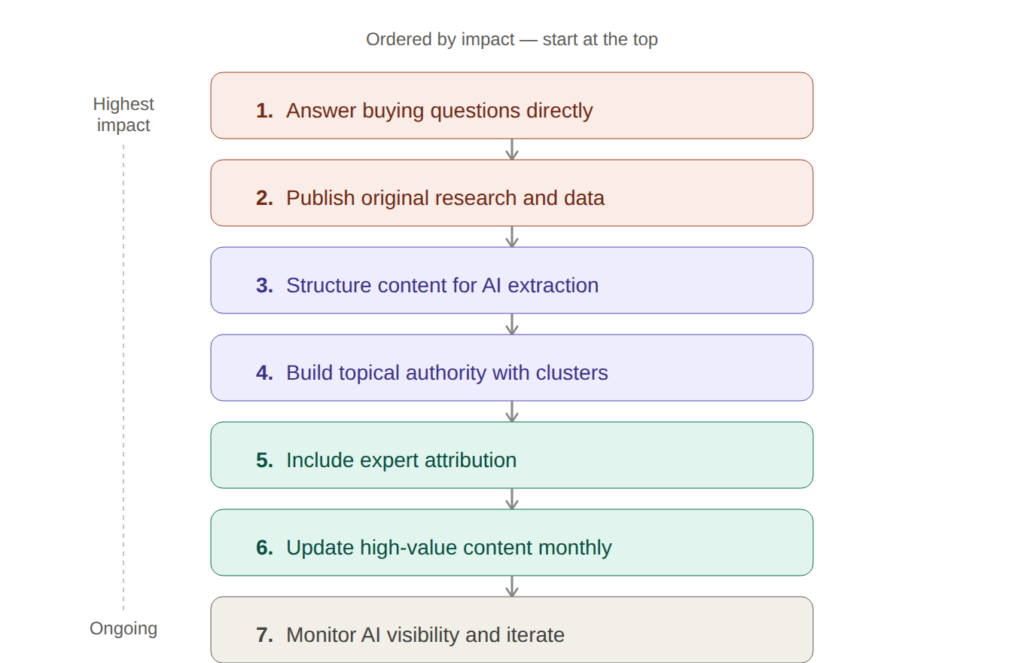
These are the specific actions that have moved the needle for B2B brands we have worked with. They are ordered by impact — start at the top.
1. Answer buying questions directly in your content
AI models are responding to prompts that look like buying questions: “What are the best project management tools for enterprise teams?” or “Compare HubSpot vs Salesforce for mid-market B2B.”
Your content needs to answer these exact questions — clearly, directly and within the first few paragraphs. Do not bury your answer under 800 words of preamble. State your position, then support it with evidence. AI models extract answers from content that gets to the point.
Audit the buying questions in your space. Ask ChatGPT and Perplexity the questions your buyers would ask. Note which brands get cited and how those citations are structured. Then build content that answers the same questions more thoroughly.
2. Publish original research and proprietary data
AI models heavily favor content that contains data points, statistics and findings that cannot be found elsewhere. If you publish a survey, a benchmark report or a case study with real numbers, you become a primary source — and primary sources get cited far more often than content that simply aggregates existing information.
For B2B companies, this means turning your internal data into public content. Customer success metrics, industry benchmarks, product usage data, market surveys — all of these become citation magnets when published with clear methodology and specific numbers.
3. Structure content for extraction
AI models parse content structurally. Help them by using clear heading hierarchies, definition patterns and comparison frameworks.
Use headings that match common prompts. If buyers ask “What is the difference between X and Y?”, your H2 should be “The Difference Between X and Y” — not a clever variation that obscures the topic.
Use definition sentences. Start key paragraphs with “X is…” or “X refers to…” patterns. These are the exact structures AI models look for when building answers.
Use comparison tables. When comparing products, features or approaches, structured tables are more easily parsed than prose paragraphs. AI models extract tabular data cleanly.
4. Build topical authority through content clusters
AI models do not evaluate individual pages in isolation. They assess whether a source has broad authority on a topic. A single article about marketing automation will not earn citations — but a cluster of 15 interlinked articles covering strategy, tools, implementation, case studies and comparisons signals deep expertise.
Build content clusters around your core topics. Create a pillar page that covers the topic comprehensively, then surround it with satellite articles that go deeper on specific subtopics. Interlink them deliberately. This signals to both search engines and AI models that your site is an authoritative source on the topic.
5. Include expert attribution and credentials
Content attributed to named experts with verifiable credentials gets cited more than anonymous or brand-attributed content. AI models look for E-E-A-T signals, and a named author with relevant experience is one of the strongest.
Add author bios with specific credentials to your content. Quote internal subject matter experts by name. Reference their years of experience, roles and areas of expertise. This is not vanity — it is a direct signal that your content comes from genuine expertise.
6. Update your high-value content regularly
AI models notice recency. Content that was last updated two years ago will lose citations to a competitor’s article that was updated last month — even if the older content is more comprehensive.
Set a monthly update schedule for your most important pages. Add new data, refresh examples, update pricing, incorporate recent developments. Show a visible “last updated” date. This signals to AI systems that your content reflects current reality.
7. Monitor your AI visibility and iterate
You cannot improve what you do not measure. Use tools that track how your brand appears across AI-generated answers — which prompts trigger your citations, which competitors appear alongside you and how your share of voice changes over time.
Several platforms now offer AI visibility tracking specifically designed for this purpose. The most comprehensive options track citations across ChatGPT, Perplexity, Google AI Overviews, Gemini and Claude — giving you the data to iterate on your GEO strategy with real feedback loops. For a detailed comparison of the tools that handle this, see our guide to the best AI SEO tools for B2B marketers.
Common GEO Mistakes That Kill Your AI Visibility
Getting cited by AI is not just about doing the right things. It is also about avoiding the patterns that actively hurt your chances.
Publishing AI-generated content without editorial depth. AI models are trained to recognize thin, generated content — because they produced similar content themselves. If your article reads like a ChatGPT output, it will not be cited by ChatGPT. The irony is real. AI-generated first drafts are fine as a starting point, but they need human expertise, original insights and proprietary data layered on top.
Optimizing for keywords instead of questions. Traditional SEO teaches you to target keywords. GEO requires you to target questions — specifically, the questions buyers type into AI assistants. The shift is subtle but important. “Marketing automation software” is a keyword. “What is the best marketing automation software for mid-market B2B companies?” is a prompt. Your content needs to answer the prompt.
Ignoring content structure. A 3,000-word article with no headings, no definitions, no comparisons and no structured data is almost invisible to AI models. Structure is not just good UX — it is a technical requirement for AI extraction. Every key claim should be in a clearly labeled section with a heading that describes the content.
Letting content go stale. A pillar page you published in 2024 and never updated is losing citations every month. AI models deprioritize outdated content, especially on topics where tools, pricing and features change frequently. Monthly updates are not optional — they are the cost of maintaining AI visibility.
Treating GEO as separate from SEO. The most effective B2B content ranks on Google and gets cited by AI. These are not competing goals. The same content principles — depth, structure, authority, freshness — serve both. Build one content strategy that addresses traditional search and AI visibility simultaneously.
A Simple GEO Workflow You Can Start This Week
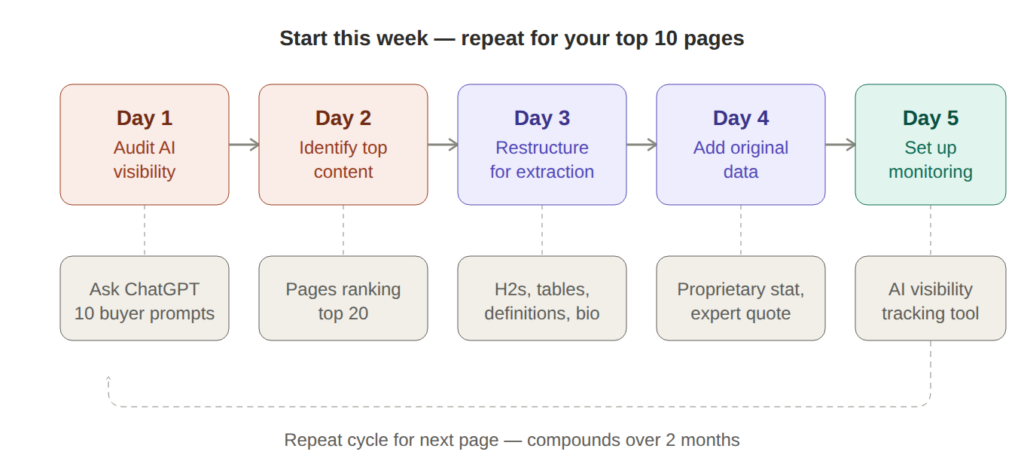
You do not need to overhaul your content strategy to start earning AI citations. Here is a workflow you can implement in the next five days.
Day 1: Audit your current AI visibility. Open ChatGPT and Perplexity. Ask the 10 buying questions your prospects ask most frequently. Note whether your brand appears. Note which competitors get cited. This is your baseline.
Day 2: Identify your highest-potential content. Look at your existing pages that rank in the top 20 for competitive terms. These already have authority signals — they are the fastest candidates for AI citation optimization.
Day 3: Restructure one page for AI extraction. Pick your highest-potential page. Add clear heading hierarchies that match buyer questions. Add definition sentences. Add comparison tables. Add a visible author bio with credentials. Add a “last updated” date.
Day 4: Add original data or expert insights. Enrich that same page with at least one proprietary data point, customer result or expert quote that cannot be found elsewhere on the web. This transforms your page from aggregated information into a primary source.
Day 5: Set up monitoring. Use an AI visibility tracking tool to monitor whether your brand starts appearing in AI-generated answers over the following weeks. Track the specific prompts, the competitors cited alongside you and your share of voice. Use this data to prioritize which pages to optimize next.
Repeat this cycle for your top 10 pages over the next two months. The compounding effect is real — each optimized page strengthens your overall topical authority, which increases the citation probability for every other page on your site.
GEO is not a tactic. It is a long-term investment in how AI systems perceive your brand’s authority. The teams that start building that authority now will own the citation landscape in their category. The teams that wait will spend the next two years trying to catch up.