
Best AI Tools for Paid Advertising — B2B Guide (2026)
B2B paid advertising in 2026 is a different game. Google’s AI-powered Performance Max campaigns now run across every Google surface with minimal human input. Meta’s Advantage+ rebuilds your audience targeting from the ground up using machine learning. LinkedIn’s Accelerate campaigns auto-generate creative, targeting and bidding in a single click.
The ad platforms themselves have become AI — which means the tools you use on top of them need to be smarter too.
If you are still running PPC the same way you did in 2024 — manual bid adjustments, static creatives, monthly reporting cycles — you are paying more for less. The B2B teams that win today combine platform AI with specialized tools that automate creative production, optimize spend in real time and surface competitive intelligence humans simply cannot process fast enough.
We tested 10 AI-powered advertising tools over three months, across Google Ads, Meta Ads and LinkedIn campaigns with real B2B budgets. This guide covers what worked, what did not, and which tools actually improve ROAS for pipeline-focused marketers.
Why B2B Paid Advertising Needs AI in 2026
The average B2B company runs paid campaigns across three to five platforms simultaneously — Google Search, Google Display, Meta, LinkedIn and often Microsoft Advertising. Each platform has its own bidding logic, attribution model and reporting interface. None of them talk to each other natively.
This creates three compounding problems that AI tools are uniquely positioned to solve:
Budget waste is invisible without cross-platform visibility. When you manage campaigns in silos, you cannot see that Google and Meta are targeting the same account with overlapping spend. AI tools that unify data across platforms catch this in real time.
Creative production cannot keep up with demand. Performance Max and Advantage+ need hundreds of creative variants to test. Manual design processes create bottlenecks that throttle the algorithms. AI creative tools produce volume at the speed the platforms require.
Optimization decisions happen at machine speed. Bid adjustments, budget reallocation and audience refinement happen at auction level — thousands of times per day. No human can match the processing speed of AI-powered automation.
For B2B specifically, longer sales cycles add another layer of complexity. A click today might convert in 90 days. AI tools with predictive analytics and cross-platform attribution help connect ad spend to pipeline in ways that last-click reporting simply cannot.
The Three Layers of AI in Paid Advertising
Not every “AI advertising tool” does the same thing. Understanding the three layers helps you pick the right tools for your stack:
Layer 1: Creative generation. AI tools that produce ad copy, headlines, images and video variants at scale. Examples: AdCreative.ai, Jasper, Pencil.
Layer 2: Campaign management and optimization. AI tools that automate bidding, budget pacing, audience targeting and rule-based actions across platforms. Examples: Optmyzr, WASK, Madgicx, Birch.
Layer 3: Intelligence and analytics. AI tools that surface competitive insights, predict performance and connect ad spend to revenue. Examples: Semrush, Anyword.
The strongest B2B advertising stacks cover all three layers — creative, management and intelligence — without overlap.
How We Evaluate AI Advertising Tools
Every tool in this guide was scored on five criteria designed for B2B paid advertising teams:
B2B use case fit. Does the tool solve problems that matter for pipeline-driven advertisers? B2B campaigns have longer cycles, smaller audiences and higher CPCs.
AI depth. Is the AI doing real work — predictive bidding, generative creative, autonomous optimization — or is it a dashboard with a chatbot bolted on?
Platform coverage. B2B teams typically run Google Ads, Meta Ads, LinkedIn Ads and Microsoft Advertising. We evaluate how many platforms each tool supports.
Pricing transparency. Ad tools frequently scale pricing with ad spend, which can create unexpected cost spikes. We flag tools where real cost diverges from listed price.
Time to value. A tool that takes three months to learn is a tool that sits unused. We evaluate how quickly a new user can start getting measurable results.
The 10 Best AI Tools for Paid Advertising, Tested and Compared
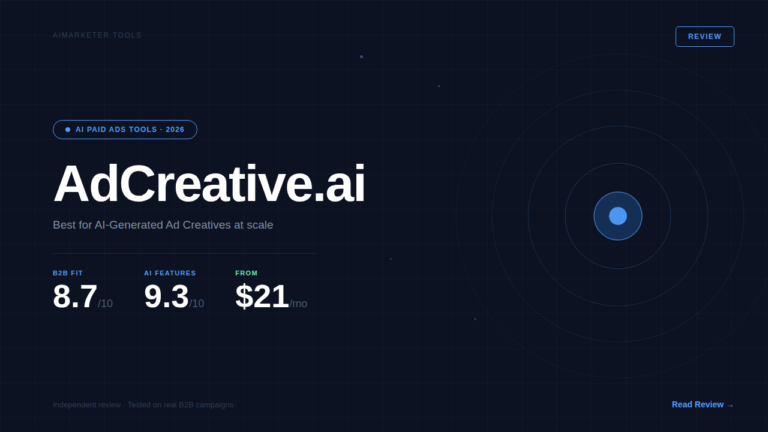
AdCreative.ai — Best for AI Ad Creative Generation
Best for: B2B teams that need high-volume, data-backed ad creatives across Google, Meta, LinkedIn and display networks.
AdCreative.ai is built for one job: generating ad creatives that convert. The platform analyzes millions of high-performing ads, then produces banners, social media creatives, video ads and ad copy optimized for your target audience and platform.
What makes it useful for B2B is the Creative Scoring engine. Every generated creative gets a performance prediction score based on historical conversion data, so you can prioritize the variants most likely to perform — before spending any budget on testing.
Honest assessment: roughly 30% of generated creatives are publish-ready. The rest need editing. Treat AdCreative.ai as a first-draft machine, not a hands-off solution. The billing model has also frustrated some users — watch the auto-renewal terms closely.
Pros: High-volume creative generation with performance prediction. Supports Google, Meta, LinkedIn, display. Brand voice training. Competitive entry price.
Cons: Only about 30% of output is immediately usable. Auto-renewal billing complaints. B2B results less consistent than B2C.
Pricing: From $14/month (50 generations) to $186/month (1,000 generations). Custom Pro plans for agencies.
The fastest way to produce ad creative variants at scale — but keep your designer in the loop.
Semrush — Best for PPC Competitive Intelligence
Best for: B2B teams that need deep competitive research on paid search before spending a dollar.
Semrush is primarily known as an SEO platform, but its PPC toolkit is one of the strongest competitive intelligence resources available for paid advertisers. The Advertising Research tool shows every keyword your competitors are bidding on, their estimated ad spend, their ad copy history and the landing pages they are driving traffic to.
For B2B teams entering competitive markets or launching new campaigns, this data is invaluable. Instead of guessing which keywords to bid on, you can reverse-engineer what is already working for competitors and build from there.
The Ads Launch Assistant uses AI to generate headlines, descriptions, sitelinks and callout extensions from a URL — producing 3-5 ad angles ready for testing. Where Semrush falls short is campaign execution. It does not manage bids, automate rules or optimize live campaigns. Pair it with an execution tool like Optmyzr or WASK for the complete stack.
Pros: Deepest PPC competitor intelligence on the market. AI ad copy generation. Years of historical ad data. 14-day free trial.
Cons: Not a campaign management tool. PPC toolkit requires the Guru plan ($249/month).
Pricing: From $139/month (Pro) to custom Enterprise. Full PPC toolkit on Guru at $249/month.
Know what your competitors are doing before you spend a dollar.
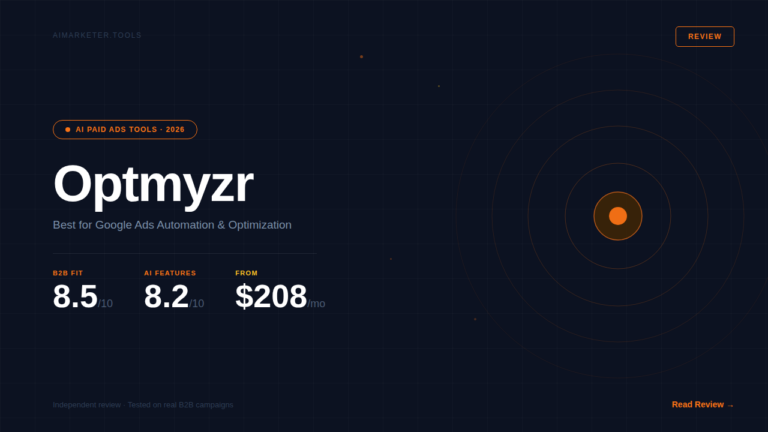
Optmyzr — Best for Google Ads Automation
Best for: Agencies and in-house teams managing $50K+ monthly in Google Ads who need governed automation at scale.
Optmyzr was founded by Frederick Vallaeys, a former Google AdWords Evangelist. The platform is built around one-click optimizations — pre-built actions that surface recommendations and let you apply changes across multiple accounts simultaneously.
For B2B teams, the standout is the Rule Engine combined with Enhanced Scripts. You can set bidding strategies, budget caps and performance thresholds that execute automatically, with full audit trails. This is the governed automation that finance teams and compliance-sensitive B2B companies need.
The main drawback is cost and complexity. Optmyzr starts at $249/month and is designed for experienced PPC managers. If you are managing less than $10K/month in spend, the ROI will not justify the price.
Pros: Best governed automation for Google Ads. One-click optimizations. Full audit trail. Script library without needing to code.
Cons: Expensive ($249/month). Steep learning curve. Primarily Google/Microsoft focused.
Pricing: From $249/month to $665/month. Custom enterprise plans.
The gold standard for Google Ads automation, if you have the spend and the expertise to match.
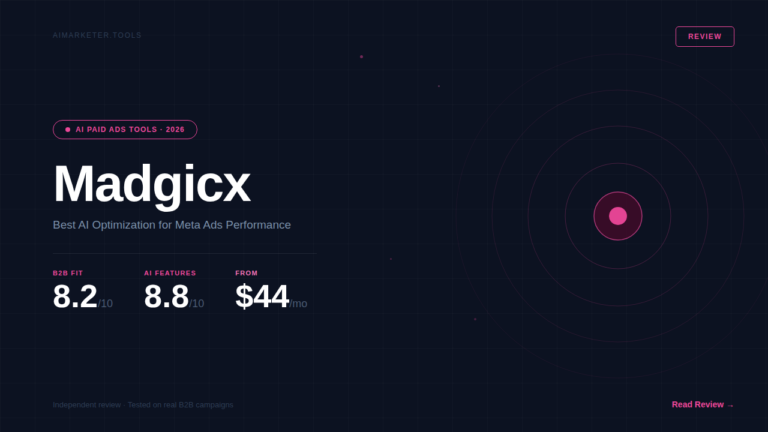
Madgicx — Best for Meta Ads AI Optimization
Best for: B2B teams running significant Meta (Facebook + Instagram) ad budgets that need AI-driven audience targeting and creative analytics.
Madgicx is purpose-built for Meta advertising. Its AI Audiences feature creates targeting clusters based on your best-performing customer segments, going beyond Meta’s native tools with layered interest, behavior and lookalike combinations.
The Creative Insights dashboard breaks down which visual elements, copy angles and formats are driving performance — not just which ads are winning, but why. For B2B teams testing multiple value propositions, this level of creative analytics is genuinely useful.
The AI Ad Generator produces creatives based on your existing best performers, and automation rules handle bid adjustments, budget reallocation and ad scheduling based on performance thresholds.
Pros: Best-in-class Meta Ads optimization. AI audience creation. Creative analytics that explain why ads work. Accessible pricing.
Cons: Meta-only — does not cover Google, LinkedIn or Microsoft. AI creatives can feel more B2C than B2B.
Pricing: From $31/month (small spend) to custom agency plans. Scales with ad spend.
If Meta is a serious channel for your B2B campaigns, Madgicx is the best dedicated optimizer available.
WASK — Best AI-Powered PPC Management Platform
Best for: Growing B2B teams and agencies that need AI-powered campaign management across Google, Meta and Microsoft Ads.
WASK is the strongest all-in-one PPC management platform for teams that want one interface to manage campaigns across multiple ad networks. The AI engine surfaces optimization opportunities automatically — flagging underperforming ad sets, recommending budget shifts and predicting which campaigns need attention.
The Smart Audience builder creates target segments from your existing data. The Campaign Optimizer automates bid adjustments and budget pacing. And the Performance Dashboard unifies Google, Meta and Microsoft data with the cross-platform visibility that most B2B teams lack.
What makes WASK compelling for B2B is the balance between AI automation and human control. The AI recommends — but you approve.
Pros: Unified cross-platform management (Google, Meta, Microsoft). AI-powered optimization. Smart audience builder. Clean interface.
Cons: No LinkedIn Ads support. Newer platform. Advanced features require higher-tier plans.
Pricing: From $19/month (Starter) to custom agency plans.
The best cross-platform PPC management tool for growing B2B teams that want AI without complexity.
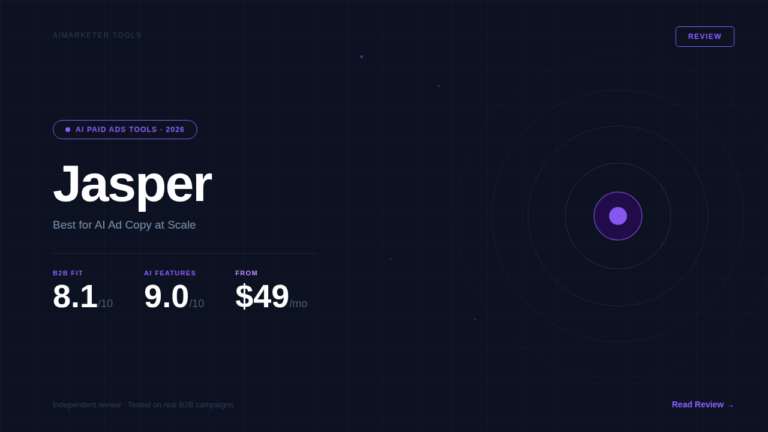
Jasper — Best for AI Ad Copy at Scale
Best for: B2B marketing teams that need on-brand ad copy, landing page content and campaign messaging produced at speed.
For paid advertising, Jasper’s value is in producing ad copy variations at the speed that modern platforms demand. Performance Max needs dozens of headline and description combinations. LinkedIn campaigns need multiple messaging angles per audience segment.
The Brand Voice training is the most sophisticated on the market — upload your style guides, past campaigns and tone preferences. The output sounds like your brand, not like generic AI. For B2B teams where messaging precision matters, this is the differentiator.
Jasper also offers campaign workflows and template libraries for specific ad types: Google Ads headlines, Meta primary text, LinkedIn Sponsored Content, email sequences and landing pages.
Pros: Best-in-class brand voice training. Templates for every major ad format. Campaign workflows for team collaboration.
Cons: Not a campaign management tool. Requires a separate tool for execution. Scales quickly for teams.
Pricing: From $49/month (Creator) to custom Business plans.
The best AI ad copywriter on the market — but it writes the words, not the strategy.
Adzooma — Best Free-to-Start PPC Optimizer
Best for: Small B2B teams and solo marketers managing modest PPC budgets who need optimization without enterprise pricing.
Adzooma is the most accessible entry point for AI-assisted PPC management. The free tier connects to Google, Meta and Microsoft Ads and provides automated optimization suggestions — budget reallocation, keyword pausing, bid adjustments and ad performance alerts.
For small B2B teams spending under $10K/month on ads, Adzooma delivers genuine value at zero cost. The AI scans campaigns weekly and surfaces a prioritized list of actions, ranked by potential impact.
The paid plans ($69-$179/month) add daily performance reports, opportunity analysis and PPC proposal builders. For agencies, the proposal builder alone can justify the upgrade.
Pros: Free tier with real functionality. Google, Meta and Microsoft support. Automated optimization suggestions. Low learning curve.
Cons: AI depth is limited compared to Optmyzr. Best for small-to-mid budgets. Advanced reporting requires paid plans.
Pricing: Free tier available. Silver at $69/month. Gold at $179/month.
The best free PPC optimizer for B2B teams that want quick wins without spending on tools.
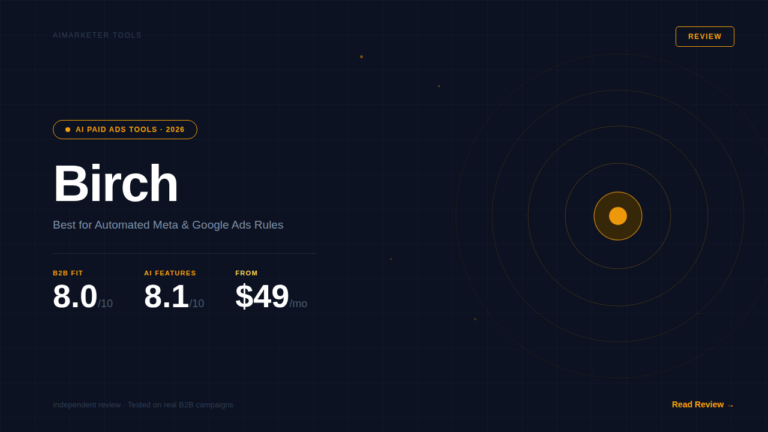
Birch (formerly Revealbot) — Best for Automated Ad Rules
Best for: Performance marketers who want granular, rule-based automation across Meta, Google, Snapchat and TikTok ads.
Birch is built around one core idea: if X happens, then do Y — but with far more sophistication than native platform rules allow. You can create custom automation rules that combine multiple conditions, triggers and actions across Meta, Google, Snapchat and TikTok.
For B2B teams running multi-platform campaigns, Birch replaces the manual monitoring that burns hours every week. Set rules for pausing underperforming ads, scaling winning campaigns, shifting budget and getting Slack alerts when metrics cross thresholds.
The Strategy Library includes pre-built automation templates for common scenarios that you can customize. Advanced users can create complex decision trees that rival what larger agencies build internally.
Pros: Most powerful rule-based automation engine. Multi-platform. Slack integration. Strategy templates for fast setup.
Cons: No native AI creative generation. Learning curve for complex rules. Pricing scales with ad spend.
Pricing: From $99/month. Scales with ad spend.
The most sophisticated rule engine for multi-platform PPC automation.
Pencil — Best for AI Video Ads
Best for: B2B teams that need AI-generated video ad variations for Meta, TikTok, YouTube and display campaigns.
Video dominates paid social performance in 2026, and most B2B teams do not have the production capacity to create enough variants. Pencil solves this by using AI to generate video ads from existing assets — product images, brand guidelines, copy and footage.
The platform analyzes past performance data to predict which creative elements will drive results, then produces video variations optimized for each platform’s format and best practices.
The output quality is good enough for performance advertising — not for brand campaigns. Think direct-response video ads, product demos and testimonial-style content, not polished brand films.
Pros: AI video ad generation from existing assets. Performance prediction. Multi-platform format optimization. Dramatically reduces production time.
Cons: Video quality is functional, not premium. Less effective for complex B2B messaging. Smaller market presence.
Pricing: Custom pricing based on volume.
The fastest path from raw assets to platform-ready video ads — ideal for testing at scale.
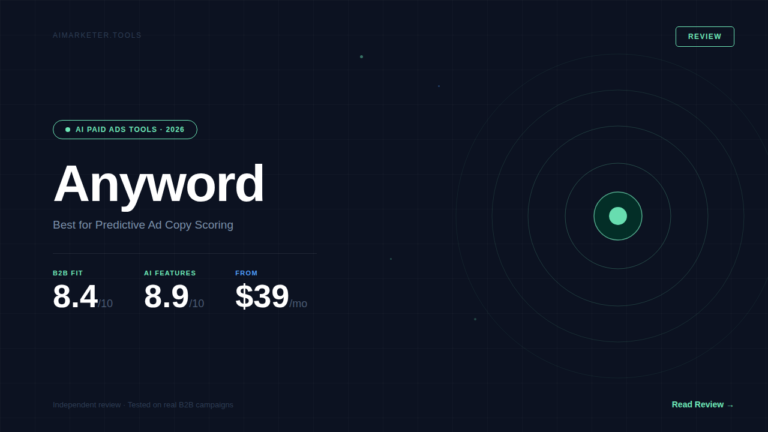
Anyword — Best for Predictive Ad Copy Performance
Best for: B2B marketers who want AI-generated copy with performance prediction scores before spending any budget.
Anyword takes a data-driven approach to ad copy. Every piece of generated text — headlines, descriptions, landing page copy, email subject lines — receives a Predictive Performance Score based on analysis of billions of data points. You see which copy variant is most likely to convert before you launch.
For B2B paid advertising, this is valuable because ad testing is expensive. Higher CPCs and smaller audiences mean each test costs more. Anyword compresses the testing cycle by eliminating weak copy variants before they ever enter the auction.
The platform covers Google Ads, Meta Ads, LinkedIn Ads, email campaigns and landing pages. The Target Audience settings let you generate copy for specific buyer personas — CMOs, IT directors, procurement managers.
Pros: Predictive performance scoring before spend. Multi-platform copy generation. Brand voice training. B2B persona targeting.
Cons: Copy-only — no creative design or campaign automation. Predictive scores are directional, not guaranteed. Pricing scales for high-volume teams.
Pricing: From $49/month (Starter) to custom Enterprise.
Know which ad copy will perform thanks to Anyword.
Discover more articles related to AI Tools for Paid Advertising
- All Posts
- Ai Tool Review
- Ai Tools for ad campaign management
- Ai Tools for better SEO ranking
- AI tools for content creation
- AI Tools for Data Analytics
- AI Tools for scaling email marketing
- AI Tools for Social Media
How Do You Stop Wasting Ad Budget with AI in B2B? The short answer: you let AI handle the three...
AI Ad Creative for B2B: How to Produce 10x More Variants Without a Design Team Performance Max wants 15 headline...
AdCreative.ai Review (2026): Is It Worth It for B2B Marketers? What is AdCreative.ai ? AdCreative.ai is an AI-powered platform built...