
Best AI Analytics & Data Tools for B2B Marketers (2026)
B2B marketing teams in 2026 are drowning in data and starving for insight. You have Google Analytics, CRM reports, ad platform dashboards, email metrics, product usage data and pipeline numbers — all telling different stories about the same customer journey.
The result is predictable. Leadership asks “which campaigns drove pipeline last quarter?” and the answer depends on who built the report, which attribution model they used and which data source they trusted. Dashboards disagree with CRM reports. Marketing claims credit for deals that sales says they sourced. Finance questions everything.
AI analytics tools solve this by doing what humans cannot: connecting fragmented data across platforms, attributing revenue across months-long buying cycles and surfacing the patterns that predict which accounts will convert — before they fill out a demo form.
We tested 10 AI analytics and data tools over three months, across real B2B marketing operations. This guide covers which tools actually close the gap between marketing activity and revenue — and which ones just create prettier dashboards for the same bad data.
The Three Layers of AI in B2B Analytics
Not every analytics tool does the same job. Understanding the three layers helps you pick the right tools for your stack:
Layer 1: Data infrastructure and dashboards. Tools that pull data from multiple platforms, unify it and visualize it in real-time dashboards. They answer “what happened?” Examples: Databox, Supermetrics, Looker Studio.
Layer 2: Attribution and revenue intelligence. Tools that connect marketing touchpoints to pipeline and revenue across long B2B sales cycles. They answer “what worked?” Examples: Cometly, HockeyStack, Dreamdata.
Layer 3: Predictive intelligence and intent data. Tools that use AI to predict which accounts will buy, identify in-market buyers and forecast pipeline. They answer “what will happen next?” Examples: 6sense, Demandbase, Mixpanel.
The strongest B2B analytics stacks cover all three layers. Most teams start with dashboards, add attribution when spend grows, then layer predictive intelligence when scaling.
How We Evaluate AI Analytics Tools
Every tool was scored on five criteria designed for B2B marketing teams:
Revenue connection. Does the tool connect marketing activity to pipeline and closed revenue? Vanity metric dashboards that stop at clicks and impressions do not qualify.
AI depth. Is the AI doing real analytical work — predictive scoring, anomaly detection, automated insight generation — or is it a chart builder with a chatbot?
B2B sales cycle fit. Does the tool handle multi-touch journeys that span months and involve multiple stakeholders? Tools designed for e-commerce impulse purchases fail at B2B attribution.
Integration depth. B2B teams run Salesforce, HubSpot CRM, Google Analytics, ad platforms and dozens of other tools. We evaluate how deeply each tool connects to the existing stack.
Pricing transparency. Analytics tools often price by data volume, events or connectors — creating surprise bills. We flag tools where costs scale unpredictably.
The 10 Best AI Analytics & Data Tools, Tested and Compared
Databox: Best AI-Powered KPI Dashboard
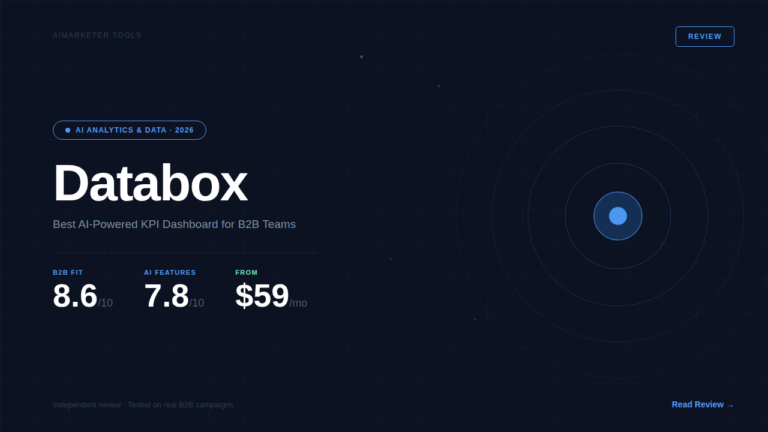
Best for: Marketing teams and agencies that need real-time dashboards connecting 100+ data sources without engineering support.
Databox pulls data from your entire marketing stack — Google Ads, Meta Ads, HubSpot, Salesforce, Stripe, GA4, LinkedIn and 100+ other platforms — into a single, customizable dashboard you can build in minutes. No SQL, no coding, no data engineering.
The AI Performance Insights automatically detect anomalies in your data and surface the metrics that need attention. Instead of scanning 50 widgets looking for problems, the AI tells you “your Google Ads CPC increased 23% this week” or “email open rates dropped below your 90-day average.”
The Goal Tracking feature lets you set targets for any metric and visually track pacing across the team. Scheduled reports deliver PDF snapshots to stakeholders automatically.
Pros: 100+ native integrations — no connectors to buy. Drag-and-drop builder. AI anomaly detection. Automated reporting. Excellent mobile app. Free tier (3 data sources). Cons: Data lives inside Databox only — no export to external BI tools. Historical data limits on lower tiers. Pricing scales with data sources. Not an attribution tool. Pricing: Free (3 sources). From $59/month (Starter). Custom Enterprise.
The fastest path from scattered marketing data to a dashboard your CEO actually checks.
Supermetrics: Best for Marketing Data Pipeline
Best for: Teams that need to pull data from 100+ marketing platforms into Looker Studio, Google Sheets, Excel, BigQuery or data warehouses.
Supermetrics is the plumbing of the analytics stack. It does not visualize data or build dashboards — it moves data from where it lives (ad platforms, CRMs, analytics tools) to where you analyze it (spreadsheets, BI tools, data warehouses). It does this job better than any competitor.
With 150+ connectors covering Google Ads, Meta, LinkedIn, TikTok, HubSpot, Salesforce and virtually every marketing platform, Supermetrics eliminates the 10-20 hours per month that teams spend manually exporting CSVs and reformatting data.
For B2B teams using Looker Studio or Google Sheets for reporting, Supermetrics is essentially required — Looker Studio’s native connectors only cover Google properties. Everything else needs Supermetrics or a similar pipeline.
Pros: Largest connector library (150+). Automated data refresh schedules. Works with Looker Studio, Sheets, Excel, BigQuery, Snowflake. Reliable and well-established. Cons: Not a dashboard or visualization tool — you still need a BI layer. Per-connector pricing adds up. No AI insights or attribution. Starter plan limited to 3 sources. Pricing: From €29/month (Starter, 3 sources). Growth at €159/month. Custom Business.
The most reliable way to get all your marketing data into one place, you just need something else to look at it.
Cometly: Best for B2B Multi-Touch Attribution
Best for: B2B teams running paid advertising who need to prove marketing ROI with accurate multi-touch attribution connected to CRM revenue.
Cometly solves the fundamental B2B attribution problem: connecting early-stage ad clicks to deals that close months later. It captures every interaction from ad click to CRM event and shows which campaigns, ad sets and channels drive actual revenue — not just leads.
The AI-Powered Recommendations analyze your attribution data and tell you which campaigns to scale, which to pause and where to reallocate budget based on actual conversion data. The Server-Side Tracking captures accurate data even when browser tracking fails due to iOS limitations or ad blockers.
Conversion Sync sends enriched data back to Meta, Google and other platforms to improve their targeting algorithms — creating a feedback loop that makes your campaigns smarter over time.
Pros: B2B multi-touch attribution connected to CRM revenue. AI recommendations for budget allocation. Server-side tracking for accuracy. Conversion sync back to ad platforms. Cons: Custom pricing only — no public pricing page. Requires CRM integration setup. Best for teams with $10K+/month in ad spend. Pricing: Custom pricing based on ad spend volume.
The attribution platform that finally answers “which marketing dollars drove revenue?” for B2B teams.
HockeyStack: Best All-in-One B2B Attribution + Analytics
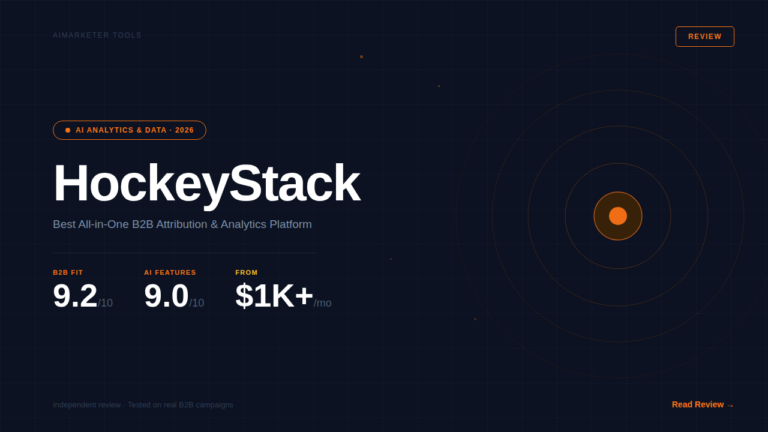
Best for: B2B marketing teams that need attribution, analytics, intent data and pipeline forecasting in one platform without building a custom data stack.
HockeyStack has emerged as the most complete B2B analytics platform in 2026. It combines multi-touch attribution, website analytics, product analytics, intent signals and pipeline forecasting in one tool — eliminating the need to stitch together five separate platforms.
The platform tracks every touchpoint — ad clicks, content downloads, website visits, email opens, product usage, sales touches — and attributes them to pipeline and revenue using multiple attribution models. The AI Lift Reports show the incremental impact of each marketing channel, going beyond correlation to measure actual influence.
Buyer Intent Signals identify which target accounts are actively researching your category, based on content consumption, website behavior and third-party intent data.
Pros: All-in-one attribution + analytics + intent. Multi-model attribution. AI lift reports. Buyer intent signals. No data engineering required. Cons: Premium pricing (custom quotes, typically $1,000+/month). Complex to set up fully. Requires buy-in from marketing and sales to maximize value. Pricing: Custom pricing. Typically starts at $1,000+/month for growth-stage companies.
The most comprehensive B2B analytics platform available, if your budget and organizational maturity justify it.
Dreamdata: Best for B2B Revenue Attribution
Best for: B2B SaaS companies that need to connect every marketing and sales touchpoint to revenue across complex, multi-stakeholder buying journeys.
Dreamdata is purpose-built for B2B revenue attribution. It ingests data from your CRM (Salesforce, HubSpot), ad platforms, website, marketing automation and sales engagement tools, then maps every touchpoint to revenue outcomes.
The B2B Customer Journey visualization shows every interaction an account had before converting, from the first ad click to the final sales call. The Content Attribution feature shows which blog posts, landing pages and resources actually influenced deals.
For B2B SaaS teams where the average deal takes 3-6 months and involves 5+ decision-makers, Dreamdata provides the attribution clarity that GA4 and ad platform reporting simply cannot.
Pros: Purpose-built for B2B revenue attribution. Account-level journey visualization. Content attribution. Free plan available. Strong Salesforce and HubSpot integration. Cons: B2B SaaS focused, less relevant for services or non-SaaS. Requires clean CRM data to deliver accurate attribution. Paid plans start at $999/month. Pricing: Free (basic attribution). Team at $999/month. Business custom.
The clearest picture of how your B2B marketing and sales touches convert to revenue.
6sense: Best for Predictive Account Intelligence
Best for: Enterprise B2B teams running account-based marketing that need AI-powered predictions of which accounts are in-market and ready to buy.
6sense is the market leader in predictive B2B intelligence. Its AI processes intent signals from across the web — content consumption, search behavior, review site visits, competitor research — and predicts which accounts are actively researching your category before they ever visit your website.
The Revenue AI platform identifies anonymous buying behavior, scores accounts by purchase readiness and orchestrates multi-channel engagement timed to the buying stage. For ABM-focused B2B teams, knowing which accounts are in-market — and at what stage — transforms how you allocate resources.
6sense also provides Dark Funnel visibility — the 70%+ of the buying journey that happens before a prospect identifies themselves. This data helps marketing and sales teams focus on accounts showing real intent, not just the ones who filled out a form.
Pros: Market-leading intent data and predictive scoring. Dark funnel visibility. Account-level buying stage prediction. Multi-channel orchestration. Enterprise-grade. Cons: Enterprise pricing (typically $25K+/year). Complex implementation (2-3 months). Requires organizational alignment between marketing and sales to maximize ROI. Pricing: Custom enterprise pricing. Typically $25K-$100K+/year.
The most sophisticated AI for predicting which B2B accounts will buy, if you are at the scale to justify it.
Demandbase: Best for ABM Analytics and Account Intelligence
Best for: B2B companies running account-based marketing that need AI-powered account identification, targeting and engagement analytics in one platform.
Demandbase One unifies advertising, sales intelligence and engagement analytics in a single ABM platform. Its AI identifies high-value accounts, scores them by likelihood of conversion and tracks engagement across every channel.
The Account Intelligence provides firmographic, technographic and intent data on target accounts. The Predictive Analytics rank accounts based on historical data and real-time buying signals. The Engagement Minutes metric measures the depth and breadth of account interaction with your brand across channels.
For B2B companies where ABM is the primary go-to-market strategy, Demandbase provides the analytics layer that proves which accounts are engaged, which campaigns are working and where to focus resources.
Pros: Complete ABM analytics platform. AI account scoring. Intent data. Engagement analytics across channels. Advertising + intelligence unified. Cons: Enterprise pricing only. Requires ABM organizational model to deliver value. Complex to implement fully. Best for 500+ account lists. Pricing: Custom enterprise pricing. Typically $30K+/year.
The analytics backbone for B2B companies where ABM is the go-to-market strategy.
Mixpanel: Best for B2B Product-Led Growth Analytics
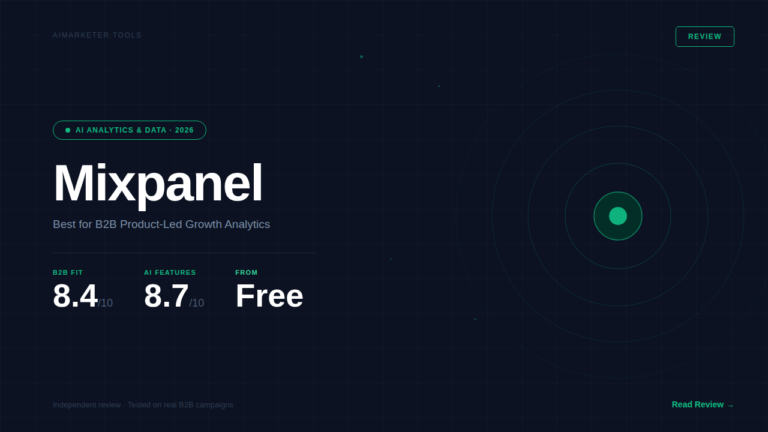
Best for: B2B SaaS companies with freemium or free trial models that need to understand which product behaviors predict conversion and retention.
Mixpanel tracks individual user actions inside your product and surfaces the behavioral patterns that predict conversion. For product-led B2B companies, this is the data that connects product usage to pipeline.
The Funnel Analysis shows exactly where trial users drop off before converting. The Retention Cohorts reveal which features keep users coming back. The AI Insights automatically surface statistically significant trends in user behavior — things like “users who complete the onboarding wizard within 24 hours are 3.2x more likely to convert.”
Pros: Best-in-class product behavior analytics. Funnel and retention analysis. AI-powered insights. Generous free tier (20M events/month). Clean, intuitive interface. Cons: Product analytics only — no ad attribution, CRM integration or marketing channel analytics. Requires engineering to implement event tracking. Not designed for traditional marketing teams. Pricing: Free (20M events/month). Growth from $24/month.
The analytics that tell you which product behaviors predict revenue, essential for PLG B2B companies.
Amplitude: Best for Enterprise Product + Marketing Analytics
Best for: Larger B2B SaaS companies that need enterprise-grade behavioral analytics with experimentation and predictive capabilities.
Amplitude is the enterprise alternative to Mixpanel, offering deeper analysis for companies with complex products and large user bases. Its Behavioral Cohorts let you define user segments based on any combination of actions and attributes, then track how those cohorts behave over time.
The Northstar Metric framework helps teams align around the metrics that matter most. The Pathfinder feature visualizes every possible user journey through your product, revealing unexpected patterns. The Experimentation Platform connects analytics directly to A/B testing decisions.
Predictive Analytics forecast which users are likely to convert, churn or upgrade, giving product and marketing teams time to intervene before outcomes are decided.
Pros: Deepest behavioral analytics available. Predictive analytics for conversion and churn. Built-in experimentation platform. Northstar metric alignment. Enterprise-grade governance. Cons: Complex to set up and learn. Expensive at scale. Engineering-heavy implementation. Overkill for early-stage companies. Pricing: Free (10M events/month). Growth from custom pricing. Enterprise custom.
The most powerful behavioral analytics engine, for teams with the resources to use it.
Whatagraph: Best for B2B Agency Reporting
Best for: Marketing agencies and in-house teams that need white-label, automated cross-channel reporting with visual dashboards.
Whatagraph is built for the agency use case: managing multiple clients, each with multiple ad platforms, and delivering professional reports automatically. The platform connects to 45+ marketing channels and produces visual reports that clients actually understand.
The AI Insights feature automatically generates performance summaries and highlights, turning raw data into narrative commentary that explains what happened and why. Automated report scheduling delivers to client inboxes on a cadence you set.
The Cross-Channel Blending feature combines data from different platforms in single charts, compare Google Ads performance against LinkedIn Ads performance in one visualization without manual data manipulation.
Pros: Best visual reporting for agencies. White-label branding. Automated report delivery. AI-generated performance summaries. Cross-channel data blending. Cons: Agency-focused, less relevant for single-brand teams. Pricing starts at $229/month (Boost plan). Limited advanced attribution. No predictive analytics. Pricing: Free (limited). From $229/month (Boost). Custom Enterprise.
The reporting tool that makes agencies look brilliant, with AI writing the narrative for you.
Which Tool Should You Pick? A Decision Framework
“We cannot see all our marketing data in one place.” → Start with Databox for dashboards or Supermetrics for data pipelines into your existing BI tools.
“We cannot prove which campaigns drive revenue.” → Start with Cometly if paid ads are your primary channel, Dreamdata for full-journey B2B SaaS attribution, or HockeyStack for the most complete solution.
“We do not know which accounts are in-market before they contact us.” → Start with 6sense or Demandbase for predictive intent data. Both require enterprise budget and ABM organizational alignment.
“We need to understand product usage to improve trial conversion.” → Start with Mixpanel for simplicity or Amplitude for enterprise-grade depth.
“We need to deliver professional reports to clients every month.” → Start with Whatagraph for visual, white-label agency reporting.
“We are a startup with minimal budget.” → Start with Databox free (3 sources) + Mixpanel free (20M events) + Google Analytics 4 (free). This covers dashboards, product analytics and web analytics at zero cost.
→ Need AI tools for organic search? See our AI SEO tools guide. Running paid campaigns? Check our AI paid advertising tools. Building email campaigns? See our AI email marketing tools.
How to Build Your AI Analytics Stack on a Budget
Free — $0/month Databox free (3 sources) + Mixpanel free (20M events) + GA4 + Looker Studio. This covers KPI dashboards, product analytics, web analytics and visual reporting at zero cost.
Starter — $50–100/month Databox Starter ($59) + Supermetrics Starter (€29). Unified dashboards with data from all your marketing platforms flowing into Looker Studio or Sheets.
Professional — $500–1,500/month HockeyStack or Dreamdata + Databox + Mixpanel. Full multi-touch attribution, intent signals, KPI dashboards and product analytics.
Enterprise — $3,000+/month 6sense or Demandbase + Cometly + Amplitude. Predictive account intelligence, ad attribution, enterprise product analytics and full-funnel visibility.
Frequently Asked Questions
What is the best AI analytics tool for B2B marketing in 2026?
It depends on your biggest analytics gap. For dashboards, Databox is the fastest to set up. For revenue attribution, HockeyStack and Dreamdata lead. For predictive intent data, 6sense is the market leader. Most B2B teams need two to three tools covering different layers.
What is the difference between marketing analytics and marketing attribution?
Marketing analytics tools (Databox, GA4, Mixpanel) show what happened: traffic, engagement, conversions. Attribution tools (Cometly, HockeyStack, Dreamdata) connect those events to pipeline and revenue, answering which marketing activities actually drove deals.
Do I need a multi-touch attribution tool if I already use GA4?
Yes, for B2B. GA4 is session-based and struggles with buying journeys that span months and multiple stakeholders. Dedicated B2B attribution tools track account-level journeys across all touchpoints and connect to CRM revenue data, something GA4 cannot do natively.
Can Looker Studio replace paid analytics tools?
Partially. Looker Studio is excellent for visualizing Google-ecosystem data (GA4, Google Ads, Search Console) for free. But it requires paid connectors (Supermetrics) for non-Google data, has no attribution capabilities and no AI insights. It works as part of a stack, not as a complete solution.
How do I choose between 6sense and Demandbase?
Both are enterprise ABM platforms with predictive intelligence. 6sense is stronger on anonymous buyer identification and dark funnel visibility. Demandbase is stronger on unified advertising + intelligence + engagement analytics. Choose based on whether prediction (6sense) or activation (Demandbase) is your bigger gap.