
Best AI Content Writing Tools for B2B (2026)
Content is still how B2B brands build trust, generate demand and feed pipeline. But in 2026, the production demands have outpaced what most teams can deliver. You need blog posts, thought leadership articles, case studies, landing pages, email sequences, social posts and sales enablement content, all on-brand, all optimized, all published faster than ever.
AI content writing tools have gone from experimental to essential. The best platforms in 2026 do not just generate words. They learn your brand voice, enforce style guides across teams, automate entire content workflows and optimize for both search engines and AI-generated answers.
But the gap between tools that produce usable B2B content and tools that produce generic filler has never been wider. A tool trained on consumer copy will not write a convincing enterprise case study. A tool without brand voice training will not maintain consistency across six writers and three agencies.
We tested 10 AI content writing tools over three months on real B2B content programs. This guide covers what produced content we could actually publish, what required heavy editing, and what wasted more time than it saved.

The Three Layers of AI Content Writing
Not every writing tool serves the same purpose. Understanding the three layers helps you pick the right tools:
Layer 1: AI writing and generation. Tools that produce drafts, blog posts, landing pages, ad copy, social posts from prompts, briefs or outlines. They handle the blank-page problem. Examples: Copy.ai, Writer, Notion AI, ChatGPT, Rytr.
Layer 2: Content editing and enhancement. Tools that improve existing content, grammar, clarity, readability, tone, style guide compliance. They handle the quality control problem. Examples: Grammarly, ProWritingAid, Hemingway.
Layer 3: Content workflow and automation. Tools that automate the entire content pipeline from ideation to research to drafting to optimization to publishing. They handle the scale problem. Examples: Copy.ai Workflows, Writer, Notion AI, Contenful AI.
The strongest B2B content teams use tools from all three layers: generation, editing and workflow automation, working together.
How We Evaluate AI Content Writing Tools
Every tool was scored on five criteria designed for B2B content teams:
Brand voice fidelity. Can the tool learn and maintain your brand’s specific tone, terminology and style? B2B content that sounds generic damages trust. This is the most important criterion for enterprise teams.
B2B content quality. Does the output handle B2B complexity, technical concepts, multi-stakeholder messaging, long-form arguments, data-driven claims? Consumer-focused tools produce copy that reads like advertising, not thought leadership.
Workflow integration. Does the tool fit into how content teams actually work: briefs, outlines, drafts, reviews, approvals, publishing. Standalone generators that require copy-pasting into five other tools create friction.
AI depth. Is the AI genuinely improving over time, learning from feedback, enforcing style guides, catching compliance issues, or is it a stateless prompt generator that starts from zero every time.
Pricing transparency. Content tools price by words, seats, credits or features. We flag tools where the real cost of producing content at B2B volume diverges from the advertised price.
The 10 Best AI Content Writing Tools — Tested and Compared
Copy.ai: Best for AI Content Workflows
Best for: B2B marketing and sales teams that need to automate content pipelines beyond just writing from research to publishing.
Copy.ai has evolved from a simple text generator into a GTM workflow automation platform. The Workflow Builder lets you create custom content pipelines: research triggers outline generation, which triggers first draft, which triggers SEO optimization, which triggers publishing. For teams producing dozens of pieces per month, this automation eliminates the coordination overhead that kills content velocity.
The AI handles multiple content formats: blog posts, emails, social posts, product descriptions, sales sequences and ad copy, with templates that actually work for B2B messaging. The Brand Voice feature learns your tone and enforces it across all output.
The sales-focused templates are a differentiator: battle cards, objection handlers, product one-pagers and outbound sequences that speak to B2B buyers, not consumers.
Pros: Workflow automation beyond just writing. Strong B2B sales and marketing templates. Brand voice training. Free tier available for testing. Multi-format output. Cons: Output quality varies: strong for short-form, weaker for long-form thought leadership. Workflow builder has a learning curve. Pro plan at $49/month. Pricing: Free tier available. Pro at $49/month. Team and Enterprise custom.
The content tool that automates the pipeline, not just the writing.
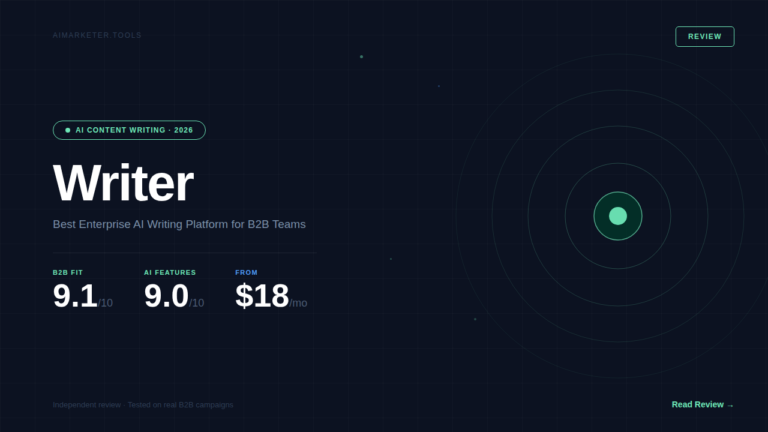
Writer: Best for Enterprise Content Governance
Best for: Large B2B organizations in regulated industries that need AI writing with strict brand compliance, style guide enforcement and terminology management.
Writer takes a governance-first approach that no other tool matches. The platform actively enforces style guides in real time, flagging terminology violations, tone inconsistencies and compliance issues before content goes live. For B2B companies in healthcare, financial services, legal or enterprise tech, this proactive compliance checking is non-negotiable.
The Knowledge Graph feeds company-specific context: products, policies, terminology, competitive positioning, into every piece of AI-generated content. This prevents the generic output that plagues tools without organizational context.
The AI Guardrails prevent the platform from generating content that violates company policies or regulatory requirements. For B2B content teams where a single compliance failure can trigger legal review, this feature alone justifies the investment.
Pros: Best-in-class style guide enforcement. Knowledge Graph for company-specific context. AI Guardrails for compliance. SOC 2 Type II compliant. Enterprise SSO. Cons: Enterprise pricing (Team at $18/user/month, Enterprise custom). Less accessible for small teams. Not a consumer-friendly UX, built for organizations. Pricing: Team at $18/user/month. Enterprise custom pricing.
The enterprise writing platform for B2B teams where compliance and brand governance are not optional.
Notion AI: Best for Integrated Content Workspace
Best for: B2B teams that already use Notion and want AI writing, editing and automation embedded in their existing workspace without adding another tool.
Notion AI is not a standalone writing tool, it is AI embedded inside the workspace where your team already plans, writes and collaborates. This integration is its biggest advantage and its biggest limitation.
The AI helps with drafting, summarization, editing, translation and brainstorming directly inside Notion pages and databases. You can generate a first draft, refine it, get feedback and publish, all without leaving the tool your team already uses for project management, documentation and knowledge management.
For B2B teams that run their entire content operation in Notion: editorial calendars, content briefs, drafts, approval workflows, asset libraries. The AI layer eliminates tool switching entirely.
Pros: AI embedded in existing workspace. No additional tool to learn or manage. Writing, editing and brainstorming in one place. Works alongside Notion databases and wikis. $10/member/month add-on. Cons: AI quality is competent but not best-in-class compared to dedicated writing tools. Requires existing Notion subscription. No brand voice training. Limited content optimization features. Pricing: $10/member/month (add-on to paid Notion plans).
The most frictionless AI writing experience, if your team already lives in Notion.
Grammarly: Best AI Writing Assistant for Content Quality
Best for: Content teams that need AI-powered grammar, clarity, tone and style checking across every piece of B2B content before publication.
Grammarly is the quality control layer that every B2B content team needs. The AI goes beyond grammar and spelling to analyze clarity, engagement, delivery tone, inclusivity and style consistency. For teams with multiple writers, in-house and freelance, Grammarly enforces a baseline quality standard across all output.
The Generative AI features now include content drafting, rewriting and brainstorming. The Tone Detector analyzes how content will be perceived and suggests adjustments. The Brand Tones feature (Business plans) lets you define your company’s voice and check every piece against it.
The platform works everywhere: Google Docs, Microsoft Word, email, Slack, social media, through browser extensions and native integrations. This ubiquity means quality checking happens where your team actually writes, not in a separate tool.
Pros: Best grammar and clarity checking available. Works across all writing environments. Tone detection and brand voice checking. Generative AI for drafting and rewriting. Free tier is genuinely useful. Cons: Not a content strategy or SEO tool. Generative AI is an add-on, not core strength. Business plan required for brand voice features. Premium starts at $12/month. Pricing: Free (basic grammar). Premium at $12/month. Business at $15/member/month.
The quality control layer that catches what every other tool misses, across every platform your team uses.
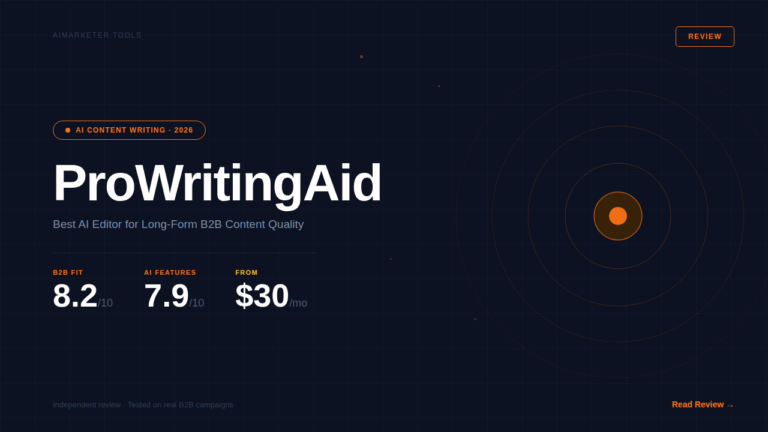
ProWritingAid: Best for Deep Content Editing
Best for: Content editors and writers who need in-depth analysis beyond grammar and style, structure, pacing, readability and writing habits.
ProWritingAid goes deeper than Grammarly on the editorial side. The platform produces 20+ writing reports that analyze style, structure, overused words, sentence length variation, readability, clichés, redundancies and pacing. For B2B content teams producing long-form thought leadership, whitepapers and guides, this level of editorial analysis improves quality significantly.
The AI Sparks feature helps with brainstorming, rephrasing and expanding ideas. Integrations with Google Docs, Word, Scrivener and WordPress mean it fits into existing workflows. The lifetime deal makes it one of the most cost-effective investments in content quality.
Pros: Deepest editorial analysis available (20+ reports). Lifetime deal option. Integrations with major writing platforms. Style and pacing analysis beyond grammar. Strong for long-form B2B content. Cons: Interface is less polished than Grammarly. AI generation is limited compared to dedicated writing tools. Free version is very limited. Less ubiquitous than Grammarly (fewer integrations). Pricing: From $10/month. Lifetime at $399 (one-time payment).
The editor’s tool isdeeper analysis than Grammarly for teams that take long-form content seriously.
Hemingway Editor: Best for Readability
Best for writers and editors who need to simplify complex B2B content for maximum readability and engagement.
Hemingway does one thing brilliantly: it makes your writing clearer. The tool highlights dense sentences, passive voice, adverb overuse and complexity: the exact problems that make B2B content unreadable. It assigns a readability grade that tells you instantly whether your content is accessible to your target audience.
For B2B teams writing about complex technical topics: enterprise software, cybersecurity, financial services, healthcare IT. Hemingway is the reality check that prevents expert-speak from alienating decision-makers.
The 2024 update added AI writing and editing capabilities, but the core value remains the readability analysis. Use it as the final pass before any B2B content goes live.
Pros: Best readability analysis available. Instant visual feedback on sentence complexity. Free web version. AI writing added in 2024 update. Forces clarity in complex B2B writing. Cons: Not a full writing tool, readability analysis only (plus basic AI). No brand voice features. No integrations with other platforms. No team features. Pricing: Free (web version). Desktop app at $19.99 (one-time).
The simplest and most effective tool for making B2B content readable, every piece should pass through it.
Copy.ai Workflows (GTM): Best for Sales Content Automation
Best for: B2B sales and revenue teams that need AI-automated content for outbound, enablement and deal support.
Copy.ai’s GTM-specific workflows deserve a separate mention because they solve a different problem than general content writing. The platform automates sales content production: battle cards, competitive one-pagers, personalized outbound sequences, meeting prep briefs and follow-up emails, all generated from CRM data and product context.
For B2B revenue teams where marketing and sales need aligned messaging, Copy.ai bridges the gap by producing sales content that matches the brand voice marketing has established.
The Salesforce and HubSpot integrations pull deal context directly into content generation. The AI knows the prospect’s industry, company size, pain points and deal stage, and tailors output accordingly.
Pros: Sales-specific content automation. CRM integration (Salesforce, HubSpot). Battle cards, one-pagers and outbound sequences. Aligns sales and marketing messaging. Cons: GTM workflows require Pro plan ($49/month). Setup complexity for CRM integration. Output quality depends on CRM data quality. Pricing: Included in Copy.ai Pro at $49/month and above.
The bridge between marketing content and sales enablement automated.
Note: Copy.ai GTM Workflows is included as a distinct use case from Copy.ai’s general content features (Tool #1). Both are part of the same platform.
Blaze AI: Best for Solo B2B Content Creators
Best for: Solo marketers, founders and small teams that need to produce blog, social and email content across multiple channels from one platform.
Blaze AI is designed for the one-person content team. The platform generates blog posts, social media content, email campaigns and website copy from a single brief, adapting the messaging and format for each channel automatically.
The Brand Voice feature learns your tone from existing content. The Content Calendar plans and schedules posts across channels. For solo B2B marketers who handle everything from blog strategy to LinkedIn posts to email newsletters, Blaze compresses the workflow into one tool.
Pros: Multi-channel content from one brief. Brand voice training. Content calendar and scheduling. Designed for solo operators. Affordable pricing. Cons: Less powerful than enterprise tools for team collaboration. Content quality is mid-tier: good for volume, needs editing for thought leadership. Smaller platform with fewer integrations. Pricing: From $25/month (Creator). Team plans available.
The one-person content team amplifier: blog, social and email from one platform.
Contentful AI: Best for Omnichannel Content Distribution
Best for: Enterprise B2B teams that need AI content generation integrated with a headless CMS for omnichannel publishing.
Contentful AI is unique on this list because it combines content generation with content distribution. Instead of writing in one tool and manually moving content to your CMS, Contentful generates content directly within the system that manages your website, mobile apps, documentation and other digital channels.
The headless CMS architecture means content created once can be automatically formatted and distributed across web, mobile, email and emerging channels. For enterprise B2B teams managing multiple digital properties, this “create once, publish everywhere” approach eliminates the reformatting bottleneck.
Pros: AI generation inside a headless CMS. Create once, publish across channels. Enterprise-grade content management. API-first architecture for custom integrations. Strong for multi-brand B2B companies. Cons: Enterprise pricing only (custom). Requires technical setup. Not for small teams — designed for organizations with complex content architecture. Overkill if you only publish a blog. Pricing: Custom enterprise pricing.
The enterprise content engine for B2B teams that publish across multiple digital channels.
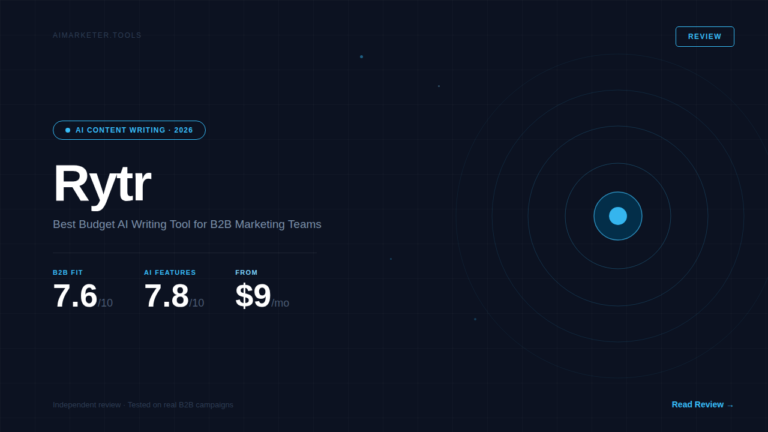
Rytr: Best Budget AI Writer
Best for: Small B2B teams and freelancers that need a versatile AI writer at the lowest possible price.
Rytr is the most affordable AI writing tool on this list. The free plan includes 10,000 characters per month, and the unlimited plan costs $9/month. For B2B teams on tight budgets that need help with blog outlines, email drafts, social posts and ad copy, Rytr delivers acceptable quality at a fraction of the price of premium tools.
The platform offers 40+ use cases and 30+ languages. The Brand Voice feature lets you define your tone. The output quality is functional but not premium, expect to edit more heavily than with Jasper or Writer.
Pros: Free plan with 10,000 characters. Unlimited plan at $9/month. 40+ use cases. Brand voice feature. Extremely low barrier to entry. Cons: Output quality is below premium tools: more editing required. No workflow automation. Limited integrations. No compliance or governance features. Small team behind the product. Pricing: Free (10K chars/month). Saver at $9/month. Unlimited at $29/month.
The cheapest way to start with AI writing : perfect for budget-conscious B2B teams that can invest editing time.
Which Tool Should You Pick? A Decision Framework
“We need to produce more content faster without adding headcount.” → Start with Copy.ai for workflow automation or Blaze AI if you are a solo operator.
“We need to ensure every piece of content meets brand and compliance standards.” → Start with Writer for enterprise governance or Grammarly Business for lighter brand voice enforcement.
“We want AI writing without adding another tool to our stack.” → Start with Notion AI if your team already uses Notion for content operations.
“Our content is too complex and hard to read.” → Run everything through Hemingway for readability, then ProWritingAid for deeper editorial analysis.
“We need sales content that aligns with marketing messaging.” → Start with Copy.ai GTM Workflows with CRM integration.
“We publish across multiple digital channels and need a CMS with AI.” → Start with Contentful AI for enterprise omnichannel content.
“We have almost no budget.” → Start with Rytr free plan + Grammarly free + Hemingway web (free). All three at zero cost gives you generation, quality control and readability analysis.
→ Need AI tools for SEO optimization alongside content writing? See our AI SEO tools guide. Looking for ad copy tools? Check our AI paid advertising tools. Building email campaigns? See our AI email marketing tools. Need analytics? See our AI analytics tools.
How to Build Your AI Content Writing Stack on a Budget
Free: $0/month Rytr free (10K chars) + Grammarly free + Hemingway web. Generation, quality control and readability analysis at zero cost.
Starter: $25–60/month Copy.ai free + Grammarly Premium ($12) + Blaze AI ($25) or Rytr Unlimited ($9). Multi-channel content with quality control.
Professional: $80–150/month Copy.ai Pro ($49) + Grammarly Business ($15/user) + ProWritingAid ($10). Workflow automation, brand voice enforcement and deep editorial analysis.
Enterprise: $300+/month Writer ($18/user) + Grammarly Business ($15/user) or ProWritingAid. Full governance, compliance, Knowledge Graph and style guide enforcement for regulated B2B organizations.
Frequently Asked Questions
What is the best AI content writing tool for B2B in 2026?
Copy.ai for workflow automation and multi-format content. Writer for enterprise governance and compliance. Grammarly for quality control across all writing. The right choice depends on whether your bottleneck is production speed, brand consistency or content quality.
Can AI writing tools produce publish-ready B2B content?
Rarely. The best tools produce strong first drafts that require human editing for accuracy, nuance, brand alignment and strategic messaging. Plan for 20-40% editing time on AI-generated content. Tools with brand voice training (Copy.ai, Writer) produce output closer to publish-ready.
What is the difference between AI writing tools and AI editing tools?
Writing tools (Copy.ai, Writer, Rytr) generate content from prompts. Editing tools (Grammarly, ProWritingAid, Hemingway) improve content you have already written. Most B2B teams need both: generate with one, refine with the other
How do I maintain brand voice when using AI writing tools?
Use tools with brand voice training (Copy.ai, Writer, Grammarly Business). Upload your style guides, past content and tone preferences. Review every piece before publishing. The tools enforce consistency, but human judgment ensures strategic alignment.
How much should a B2B team spend on AI writing tools?
Small teams can start free with Rytr, Grammarly and Hemingway. Most established B2B content teams spend $80-$150/month across writing and editing tools. Enterprise teams in regulated industries invest $300+/month for governance and compliance features.
Will AI writing tools replace content writers?
No. AI handles the production bottleneck — drafting, variant generation, repurposing, formatting. Human writers handle strategy, messaging, original thinking, subject-matter expertise and the editorial judgment that AI cannot replicate. The best B2B content teams use AI to amplify writers, not replace them.
What is the best free AI writing tool for B2B?
Rytr’s free plan (10K characters/month) for generation. Grammarly’s free plan for grammar and clarity. Hemingway’s web version for readability. Combined, these three free tools cover the basics of AI-assisted content production.
Our Verdict
B2B content writing in 2026 requires three things working together: tools that generate drafts at speed, tools that enforce quality and brand standards, and tools that automate the workflow that connects them.
If you solve one problem first, make it workflow automation. Copy.ai’s pipeline automation eliminates the coordination overhead that kills content velocity for most B2B teams.
If brand consistency is your biggest risk, invest in Writer for enterprise governance or Grammarly Business for lighter enforcement. Inconsistent brand voice erodes trust faster than slow publishing.
If budget is the constraint, the free combination of Rytr + Grammarly + Hemingway gives you generation, quality control and readability analysis at zero cost. You can build a genuine content operation on this stack.
If you are already in Notion, add Notion AI at $10/member/month before buying anything else. The integration advantage outweighs the AI quality gap.
AI writing tools do not replace your content team. They replace the production bottleneck that prevents your team from focusing on the strategic, creative and expertise-driven work that actually differentiates your brand. Every B2B team that has not made this shift is publishing less, slower and at higher cost than teams that have.
- All Posts
- Ai Tool Review
- Ai Tools for ad campaign management
- Ai Tools for better SEO ranking
- AI tools for content creation
- AI Tools for Data Analytics
- AI Tools for scaling email marketing
- AI Tools for Social Media
Which AI Cold Email Tool Wins for B2B Sales in 2025? Which is the best AI cold email tool for...
Why AI Is Now the Backbone of B2B Email Deliverability How does AI improve email deliverability in 2026? AI improves...
AI Cold Emails That Get Replies: B2B Playbook for 2026 Why Most AI Cold Emails Fail (And How to Fix...
How Do You Stop Wasting Ad Budget with AI in B2B? The short answer: you let AI handle the three...
AI-Powered Technical SEO: Why Manual Audits Are Already Obsolete What is AI-powered technical SEO? It is the use of artificial...
How to Audit Your Website for AI Visibility in 60 Minutes Why Your Website Needs an AI Visibility Audit Right...
AI Ad Creative for B2B: How to Produce 10x More Variants Without a Design Team Performance Max wants 15 headline...
How to Get Your B2B Brand Cited by ChatGPT, Perplexity and Google AI Overviews Your buyers are asking AI for...
AdCreative.ai Review (2026): Is It Worth It for B2B Marketers? What is AdCreative.ai ? AdCreative.ai is an AI-powered platform built...